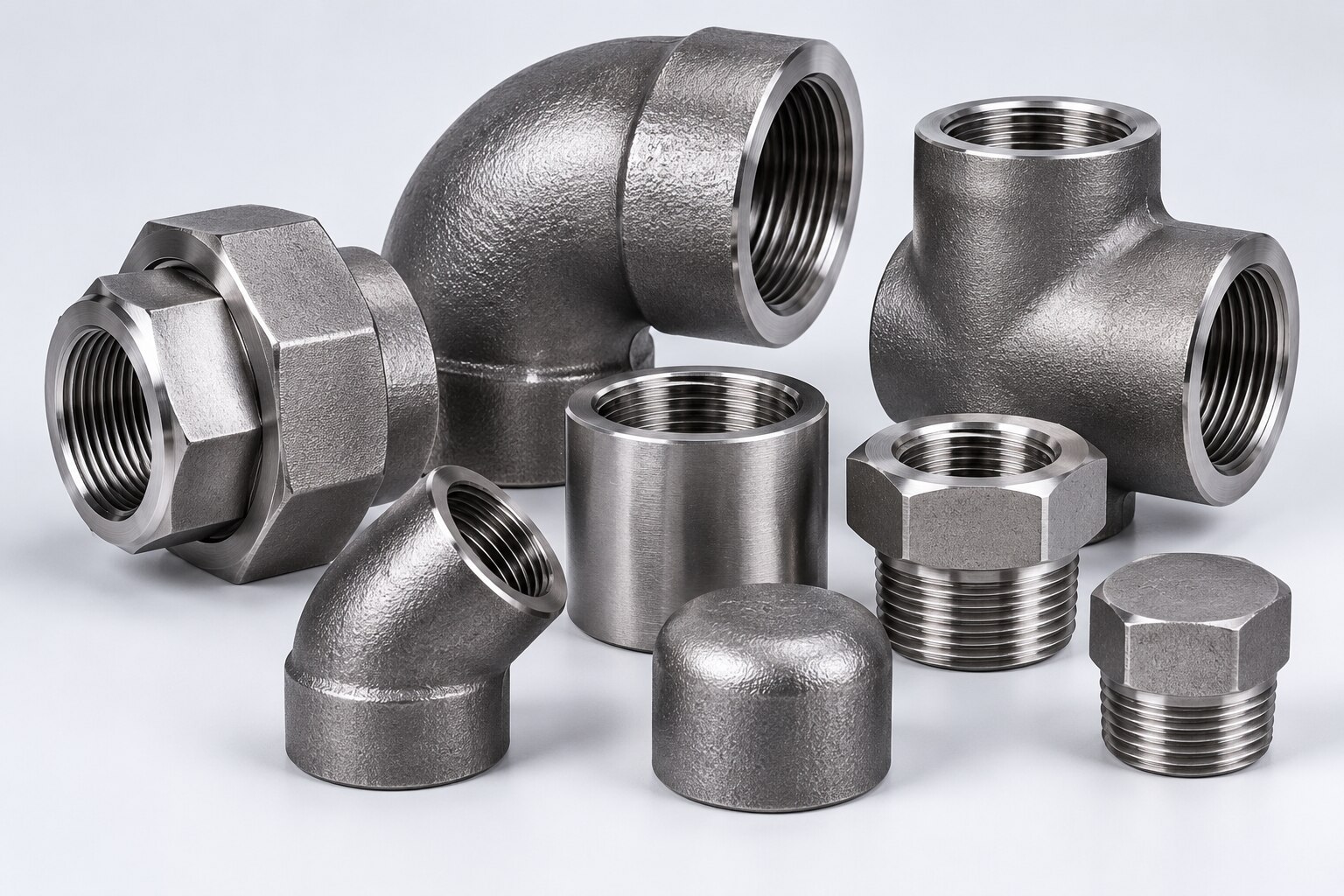
A Class 6000 marking does not by itself tell you the pressure a fitting can handle, and a fitting that matches the nominal pipe size can still fail to mate with its thread, socket or valve. You will be able to specify the connection, material, dimensions, pressure-temperature basis and documentation needed for a safe purchase.
Key takeaways
- Select socket-weld or threaded ends to match the pipe connection and installation method.
- Compare ASME B16.11 class markings with pressure-temperature ratings and dimensions.
- Request material certificates, heat numbers and grade details for traceable forged fittings.
- Check bore, socket depth, thread and face dimensions before approving the order.
Choose the fitting type and end connection for the line
A socket-weld elbow, tee, coupling, half coupling, union, cap, bushing, cross or branch outlet suits a compact high-pressure layout when the pipe can be inserted into the fitting bore and welded around its outside.
Select the fitting geometry from the route: use elbows for direction changes, tees or branch outlets for take-offs, reducers or bushings for size changes, and caps for dead ends.
| Connection | Strength and limitation | Best application |
|---|---|---|
| Socket-weld | Clean, compact joint; crevices and weld inspection require control | Instrument, utility and process lines with vibration or contamination concerns |
| Threaded | Easier maintenance; thread leakage and loosening risk increase under vibration | Accessible low-diameter services where welding is impractical |
| Butt-weld | Full-penetration joint with no socket crevice; needs qualified welding and more space | Larger-bore or severe-service piping, using fittings specified to ASME B16.9 |
ASME B16.11 covers forged socket-welding and threaded fittings, not every forged elbow or tee in a catalogue. Confirm whether the item is Class 3000, 6000 or 9000 for socket-weld service, or Class 2000, 3000 or 6000 for threaded service; these designations are not standalone bar ratings.
Check them against material, temperature, wall thickness, connection type and the governing piping code.
For industrial forged fittings in Mumbai, state the fluid, design pressure and temperature, pipe schedule, corrosion allowance, joining method and inspection requirements. Match the fitting bore to the pipe, and verify branch size, flange interface and maintenance access before ordering. A B16.11 dimensional match alone does not prove system suitability.
Read the class marking against dimensions and temperature
Class 3000, 6000 or 9000 does not guarantee a fixed pressure in bar; suitability depends on the fitting material, wall thickness, connection type and operating temperature. Check the governing code, such as ASME B31.3, against design pressure, design temperature, fluid, corrosion allowance and inspection requirements before treating an ASME B16.11 mark as acceptable.
| Class | Connection | What to verify |
|---|---|---|
| Class 2000, 3000, 6000 | Threaded | Thread form, engagement, material-temperature rating and leak risk |
| Class 3000, 6000, 9000 | Socket-weld | Socket bore, weld size, pipe wall and temperature derating |
Match the fitting’s nominal pipe size and schedule or wall designation to the actual pipe. A socket-weld fitting with the wrong bore or socket depth can restrict flow or prevent the required weld; a threaded fitting with the wrong thread standard will leak or seize.
Compare flange-end dimensions with ASME B16.5, and do not substitute a butt-weld elbow or tee covered by ASME B16.9 merely because it has the same NPS.
Ask a forged fittings supplier in Mumbai to identify the class, standard edition, material grade, heat number and traceable material test certificate for each delivered item. Confirm the pressure-temperature table for the actual material, not a catalogue headline.
For boiler or regulated pressure-equipment service, verify Indian Boiler Regulations or another statutory approval before ordering; ASME marking alone does not prove compliance.
Match the material grade to service and traceability needs
A material name alone does not prove suitability. Put the ASTM specification, grade suffix, heat-treatment condition and inspection documents in the purchase order, then match them to temperature, corrosion, welding and pressure-service risks.
| Material/service | Specify | Require before acceptance |
|---|---|---|
| Carbon steel, ambient or elevated temperature | ASTM A105/A105M | EN 10204 3.1 material test certificate (MTC), heat number, chemical analysis, tensile and yield results, and heat-treatment details |
| Carbon steel, low-temperature service | ASTM A350/A350M LF2 | MTC plus Charpy impact-test temperature, absorbed-energy results, heat number and hardness results |
| Stainless steel | ASTM A182/A182M F304/L or F316/L | MTC, PMI report, solution-annealing record, corrosion-relevant chemistry and heat traceability; confirm the L suffix where weldability and sensitisation control matter |
| Alloy steel | ASTM A182/A182M F5, F11 or F22 | MTC, chemistry, tensile results, hardness, heat-treatment chart or record, PMI and heat number; F11 and F22 need alloy-grade and temper verification |
| Nickel alloy | ASTM B564/B564M grade such as UNS N06625 or N08825 | MTC, chemistry, tensile results, heat treatment, PMI, hardness and heat-number traceability |
Require the fitting marking to match the certificate: grade, size, class, standard and heat number. Ask for EN 10204 3.2 certification when the contract, inspector or statutory authority requires independent witnessing.
For Indian boiler or regulated pressure-equipment service, confirm Indian Boiler Regulations approval before ordering. For hydrogen-sulfide exposure, state NACE MR0175/ISO 15156 or the project sour-service specification; add hardness, heat-treatment and environmental-limit evidence. “Forged” is not sour-service qualification.
Check every mating dimension before placing the order
A fitting can carry the correct Class marking and still fail to connect: a wrong pipe schedule changes the socket bore, wall alignment or weld preparation. Before you buy forged fittings in Mumbai, obtain the mating component drawings or certified dimensions, not just nominal size and class.
1. Confirm nominal pipe size, outside diameter, schedule or minimum wall thickness, socket-weld bore and socket depth. Check the fitting against the actual pipe, not a generic “2-inch” description.
2. For threaded connections, specify thread form, size, taper and gender. ASME B1.20.1 NPT is not interchangeable with BSPT or parallel threads; the wrong form damages threads and leaks at assembly.
3. For a valve or flange connection, match the end type, nominal bore, pressure class, flange standard, facing, bolt-hole circle, bolt-hole diameter and flange thickness. ASME B16.5 dimensions govern many flanged joints, while ASME B16.11 covers socket-weld and threaded fittings.
4. For a butt-welded elbow, tee or reducer, verify outside diameter, wall thickness, end bevel, centre-to-end dimensions and the applicable ASME B16.9 specification. For a branch line, identify a socket-weld, threaded or butt-weld outlet and check MSS SP-97 dimensions and reinforcement.
Put the governing code, such as ASME B31.3, design pressure, design temperature, corrosion allowance and joining method on the purchase order. Require the standard edition, class, grade, heat number and material test certificate so the delivered fitting can be traced.
Evaluate a Mumbai stockist by evidence, not catalogue breadth
Compare a forged fitting stockist in Mumbai by the evidence attached to each item, not by the number of catalogue pages. Mixed heats, schedules and certification statuses can sit under one nominal size and class.
Ask for these before releasing the purchase order:
- Governing code, such as ASME B31.3, plus design pressure, design temperature, fluid, corrosion allowance, joining method and inspection plan.
- Material grade, ASME B16.11 or ASME B16.9 standard, standard edition, class, schedule or wall designation, and heat number.
- A heat-specific material test certificate linking the delivered fitting to chemical analysis, tensile and yield results, elongation, heat treatment, hardness and impact tests where specified.
- PMI for mixed carbon-steel, stainless-steel and low-alloy stock. PMI identifies the alloy family; it does not replace the certificate or test records.
| Evidence | Accept | Reject |
|---|---|---|
| Heat traceability | Marked fitting, matching MTC and packing list | Certificate with no heat number |
| Dimensional control | Measured end-to-end, bore, socket and thread details | “Class 6000” with no inspection record |
| Service qualification | A105/A105M or specified grade verified against service | Grade offered without temperature or fluid review |
| Sour service | NACE MR0175/ISO 15156 compliance and hardness controls | “Forged” treated as sour-service approval |
Confirm that socket-weld or threaded items are covered by ASME B16.11; butt-weld elbows, tees and reducers generally belong to ASME B16.9. Mercury Metalinks becomes worth comparing when it can provide this item-level trail rather than only a broad stock list. A B16.11 match alone does not prove fitness for the complete piping system.
Related product
 | FORGED FITTINGS Mercury Metalinks Mercury Metalinks is a trusted supplier and stockist of premium-quality Forged Fittings, offering a comprehensive range of... View product → |
Frequently asked questions
How do you choose the forged fitting type and end connection?
Choose an elbow, tee, coupling, half coupling, union, cap, bushing, cross or branch outlet based on the line layout. Select socket-weld ends when the pipe enters the fitting bore for an external weld, or threaded ends when the piping design specifies compatible threads.
What does the class marking on a forged fitting tell you?
Read the class marking alongside ASME B16.11 dimensions and the material’s pressure-temperature rating. Class 3000, 6000 and 9000 are fitting classes, not a universal pressure value at every temperature or for every alloy.
How do you match a material grade to the service?
Match the grade to fluid compatibility, operating temperature, pressure, corrosion exposure and welding requirements. Ask for the heat number and material test certificate when your quality system requires traceability.
Which dimensions must you check before ordering forged fittings?
Confirm nominal pipe size, schedule or wall thickness, socket bore and depth, thread type and size, centre-to-end dimensions, face dimensions and branch size. Compare these measurements with the mating pipe and valve connections.
How can you evaluate a forged fitting stockist in Mumbai?
Ask for dimensional standards, grade availability, material test certificates, heat-number traceability, inspection records and clear delivery commitments. Catalogue breadth alone does not prove that the required fitting is in stock or correctly documented.