Choose diameter from the part’s finished dimensions, load, span, hole or thread size, and the material you must remove during machining—not from the catalogue alone. By the end, you will be able to compare common diameters, estimate mass, select a suitable grade and form, and write a purchase specification that avoids costly mismatch and waste.
Key takeaways
- Select diameter from the finished part, load and machining allowance.
- Use standard industrial sizes before ordering a special diameter.
- Match bar form and grade to the component’s load and corrosion exposure.
- Specify diameter, grade, finish, tolerance, length and test documents.
Start with the Finished Part, Not the Stock Diameter
Choose the diameter from the finished component, not from the bar rack. Start with the required finished diameter, load, unsupported span, bending or buckling risk, hole size, thread size, and corrosion exposure. A larger bar is not automatically safer: it adds cutting, heating, welding, lifting, and machining cost.
For round bar size selection in Mumbai, define the part before requesting stock:
- State the finished diameter and tolerance, such as 20.00 mm with a specified dimensional class, rather than “20 mm bar.”
- Add the grade, supply condition, length, and applicable standard. A hot-rolled black bar and a bright-drawn bar can share a nominal diameter but differ in finish, straightness, and accuracy.
- Add machining allowance for turning, drilling, threading, keyways, or grinding. Ask the machinist to set the allowance; the correct amount depends on the operation and the required final tolerance.
- Check the feature that controls fit: a shaft needs diameter, straightness, and concentricity; a threaded pin needs the major diameter, thread form, pitch, and run-out; a spacer needs finished length and flat ends.
- Select the smallest available commercial size that survives the calculated load and fabrication process. Common stock includes 6, 8, 10, 12, 16, 20, 25, 32, 40, 50, 63, and 75 mm, subject to grade and inventory.
Specify whether you need hot-rolled, bright-drawn, peeled, or ground bar. Buying bright bar for a part that will be heavily machined wastes money; buying hot-rolled bar for a close-fit rotating shaft creates rework.
Use Common Industrial Sizes Before Requesting a Special Diameter
Choose the smallest stocked diameter that meets the part’s finished strength, stiffness, thread, hole, and bending requirements. Common industrial round bar sizes reduce cutting waste and waiting time; a special diameter can require a mill order or machining from larger stock.
| Size | Suitable fabrication use | Selection note |
|---|---|---|
| 6–8 mm | Handles, light pins, small spacers | Check bending and thread-root strength |
| 10–12 mm | Brackets, clevis pins, light shafts | Allow for drilled holes and weld distortion |
| 16–20 mm | Pins, shafts, rollers, support members | Confirm span, shear, and bearing loads |
| 25–32 mm | Machine shafts, heavy pins, threaded rods | Specify straightness and concentricity |
| 40–50 mm | Rollers, columns, large pins, frame supports | Handling and turning costs rise sharply |
| 63–75 mm | Heavy shafts, posts, fabricated hubs | Buy only after checking lifting and machining capacity |
| 100 mm | Large rollers, bosses, structural supports | Compare against hollow section to reduce mass |
For round bar for fabrication that will be turned, threaded, peeled, or ground, do not order the finished diameter blindly. A 30 mm finished shaft needs stock above 30 mm if scale, ovality, dents, decarburised material, or straightness error must be removed.
State the minimum finished diameter and agree the machining allowance with the fabricator; no universal allowance suits every operation.
Ask whether the quoted size is nominal or guaranteed minimum, and whether the bar is hot-rolled, cold-drawn, peeled, ground, or forged. Bright or ground bar reduces machining, but it does not automatically provide higher strength or better weldability.
Match the Bar Form and Grade to the Component
Choose the grade from the load and environment, then choose the form from the component’s geometry. A larger diameter will not fix chloride pitting, excessive deflection, poor weldability, or unnecessary machining cost.
| Option | What it means | When it applies |
|---|---|---|
| Mild steel | Low-carbon, weld-friendly steel | Use for welded frames, brackets, support posts, handles, and general fixtures where corrosion protection comes from paint, galvanising, or indoor service. |
| EN8 or C45 | Medium-carbon steel with higher strength and wear resistance | Use for shafts, pins, rollers, and heavily loaded spacers. Plan machining carefully, and use a qualified welding procedure because direct welding can produce cracking or a hard heat-affected zone. |
| 304 stainless steel | Corrosion-resistant austenitic stainless steel | Use for food, clean-water, and indoor wet-service components without severe chloride exposure. |
| 316 stainless steel | Stainless steel containing molybdenum for better chloride-pitting resistance | Choose it for coastal air, wash-down areas, and chloride-bearing process service. Crevices, deposits, and stagnant liquid can still corrode it. |
| Hollow section or pipe | Material placed around a void | Use for frames, posts, guards, and long members where bending stiffness and low weight matter more than a solid core. |
| Flat, square, or hex bar | A profile that provides faces or flats | Choose flat bar for brackets and plates, square bar for direct-welded frames, and hex bar for wrenching features or small turned parts. |
For round bar for fabrication, select the smallest commercial diameter that meets strength, stiffness, thread, hole, and corrosion requirements after machining allowance. State the grade, condition, tolerance, length, and standard number; “20 mm” alone does not distinguish hot-rolled from bright-drawn material.
Verify whether the purchase cites IS 2062, ASTM A276/A276M, ASTM A29/A29M, or an EN specification.
Check Weight, Handling and Mumbai Site Conditions Before Ordering
A 25 mm solid bar weighs about 3.85 kg per metre, compared with 2.47 kg for a 20 mm bar. The larger diameter increases lifting effort, cutting time, machining volume, truck weight, rack loading and the cost of every remnant.
1. Calculate mass before ordering. Use diameter² ÷ 162.2 to estimate kilograms per metre, then multiply by the actual bar length and quantity. Check this figure against the quotation and dispatch weight; a six-metre 25 mm bar weighs about 23.1 kg before cutting.
2. Compare cut-to-length supply with full lengths. Full bars can reduce the unit rate, but add saw-kerf loss, loading, transport and shop labour. Cut pieces can reduce scrap and handling, while leaving less useful remnant for later work.
3. Plan the site route and storage. Confirm that the vehicle, unloading equipment, doorway, staircase, rack and workbench can handle the longest and heaviest piece. Keep bars off the ground, away from standing water and chloride-bearing contamination, and retain the heat or bundle tag after cutting.
4. Inspect before fabrication. Light surface rust on carbon steel can be cleaned, but pitting, mixed-grade bundles, missing identification or scale hidden under paint requires a hold for inspection. Include lifting, cutting, storage and scrap in the quote, not only the price per kilogram for metal round bar in Mumbai.
For a Mumbai site with limited access, a smaller standard diameter in cut lengths can cost less overall than a heavier full-length bar, even when its per-kilogram price is higher.
Give the Supplier a Specification That Can Be Inspected
State the finished diameter, permitted tolerance, grade, material condition, bar length, and applicable standard before you ask for a price. “20 mm round bar” does not identify whether you need a hot-rolled, cold-drawn, peeled, ground, or forged product.
Ask the round bar supplier in Mumbai to confirm these points in writing:
- Is the diameter nominal, or is a guaranteed minimum supplied?
- What dimensional-tolerance class, straightness, roundness, and surface condition apply?
- Are bars supplied in full lengths or cut pieces, and what cut-length tolerance applies?
- What heat-treatment condition and hardness range are required?
- Will the bar be turned, threaded, drilled, keyed, or ground?
- What machining allowance is agreed for removing scale, decarburized material, dents, ovality, or straightness error?
- For shafts, pins, and rollers, what concentricity, end condition, and thread allowance must be maintained?
Verify the delivery against the order, not against appearance alone. Check diameter with a calibrated micrometer at several positions, inspect straightness and surface defects, and match the heat number or bundle tag to the mill test certificate. Hold material with pitting, mixed grades, missing identification, or paint concealing scale.
Ask any metal round bar in Mumbai supplier how bars were stored and transported. Reject stock kept in standing water or contaminated with chloride-bearing residue until it passes inspection; light removable rust is not the same as pitting.
Mercury Metalinks can be asked to record these acceptance details on the quotation, preventing a cheaper but unsuitable bar from becoming scrap.
Related product
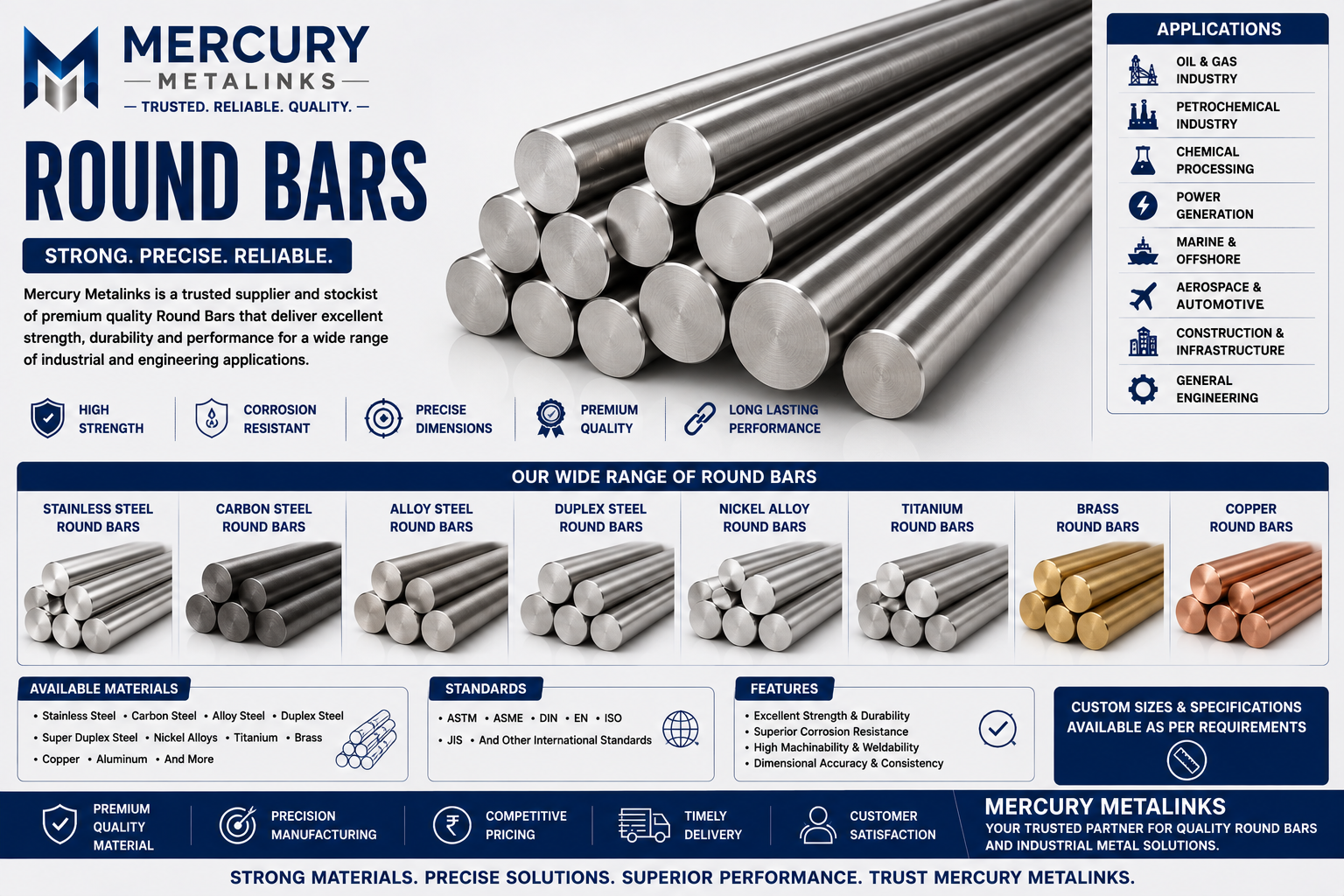 | ROUND BAR Round Bars – Mercury Metalinks Mercury Metalinks is a trusted supplier and stockist of premium-quality Round Bars, offering a comprehensive range of... View product → |
Frequently asked questions
How do you choose a round bar size for fabrication?
Start with the finished component’s diameter, load, unsupported span, bending or buckling risk, hole size and thread size. Add only the machining allowance required to reach the final dimension.
Should you use a standard industrial round bar size?
Yes, compare common industrial round bar sizes before requesting a special diameter. Standard sizes usually simplify sourcing, replacement, cutting and delivery.
Which round bar form and grade should you specify?
Choose hot-rolled, cold-drawn or precision-ground bar according to the component’s dimensional and surface requirements. Select the grade for strength, weldability, machinability and corrosion exposure.
What information should you give a round bar supplier in Mumbai?
State the nominal diameter, finished diameter, length, grade, bar form, surface condition, dimensional tolerance, quantity, cutting requirements and required inspection documents.