Round bar is worth buying when its strength, machinability, geometry and supply format match the finished part—not simply because it is easy to stock. By the end, you will be able to choose the right material and surface condition, write a purchase specification, compare usable cost, and verify that the delivered bar matches the order.
Key takeaways
- Match grade and geometry to the finished part’s load, machining and environment.
- Choose bright, black or peeled bar based on required surface and machining allowance.
- Specify grade, diameter, length, tolerance, finish, standard and test documents in writing.
- Compare usable cost after machining waste, rejects, freight and inspection time.
Match the bar to the part, not just the diameter
Round bar earns its place when the part needs a continuous load path and uniform stock around its axis: shafts, pins, axles, rollers, studs, couplings, spacers, bushes and turned fasteners. These industrial round bar applications justify the form because machining from a solid cylinder avoids joining flat sections and gives predictable rotational strength.
Round bar for manufacturing is a poor choice for brackets, plates or welded frames that do not need cylindrical geometry.
Material choice must follow the service environment, not the diameter.
| Material | Best fit | Main trade-off |
|---|---|---|
| Mild steel | Spacers, brackets, low-load shafts and reinforcement parts | Low cost, but limited strength and corrosion resistance |
| Carbon steel | Pins, axles, studs and general machined parts | Stronger than mild steel, but needs corrosion protection |
| 4140 alloy steel | High-load shafts, rollers, couplings and wear parts | Specify annealed or quenched-and-tempered condition; hardness changes machining |
| Stainless steel | Wet, washdown or corrosive service | Higher cost; grade selection controls strength and chloride resistance |
| Aluminium | Lightweight shafts, rollers and fixtures | Lower stiffness and wear resistance than steel |
| Brass | Bushes, fittings and easy-to-machine components | Unsuitable for many high-load or high-temperature duties |
| Duplex or super duplex | Chloride-rich process equipment and marine service | Expensive and demanding to machine and weld |
For a long, slender shaft, do not assume cold-drawn or ground bar will stay straight during machining. Residual stress from cold working and straightening can cause movement, so request stress-relieved material, support the work properly and inspect final runout. A tighter supplied diameter does not guarantee a stable finished part.
Choose the supply form and geometry that reduce total work
The case for round bar for manufacturing is strongest when the finished part is rotational: a shaft, pin, roller, axle, coupling, stud or bush. Choose the supply condition by the work it removes, not by appearance alone.
| Option | Choose it when | What it changes |
|---|---|---|
| Hot-rolled | Diameter allowance is large and machining is substantial | Lowest-cost starting stock, but scale, looser tolerance and more cleanup |
| Cold-drawn | You need better diameter control and a cleaner surface before machining | Less turning, though residual stress can cause distortion |
| Peeled | You need scale-free, uniform surface and improved size control on larger bars | Removes surface defects with less stock removal than full machining |
| Ground | A shaft or pin needs close size, smooth finish or controlled runout | Minimises finishing work; pay for it only when the tolerance needs it |
| Forged | The part carries high loads, impact or fatigue stress, especially at larger sections | Produces a strong grain flow, but usually leaves machining allowance |
| Bright | You need a cold-finished bar for repeatable machining or exposed appearance | Improves consistency; confirm whether “bright” means drawn, peeled or ground |
Use square or hex bar when the part has flats, a wrench interface or substantial non-round milling. For long slender shafts, do not assume cold-drawn or ground stock will stay straight: request stress relief, support the work during machining and inspect final runout. A tighter incoming diameter does not guarantee a stable finished part.
Write a purchase specification that leaves no room for substitution
Write “ASTM” alone and you have not specified a bar. Your enquiry and purchase order for metal round bar procurement should state:
1. Name the material precisely: grade, governing product standard, and heat-treatment condition. For example, specify ASTM A108 for a cold-finished carbon or alloy steel bar, or ASTM A29/A29M where its general requirements apply. Add the required chemical composition and mechanical properties.
2. Define the geometry: nominal diameter, diameter tolerance, straightness, bar length or cut length, end condition, quantity, and supply form—hot rolled, cold drawn, peeled, turned or ground. State surface condition and finish; the same diameter and grade can produce different machining allowances and prices.
3. State inspection requirements without writing “NDT tested.” Identify ultrasonic testing or magnetic-particle testing, the applicable standard, acceptance class, sampling basis, inspection location, and report format. Surface inspection does not replace ultrasonic testing for internal discontinuities.
4. Require a heat-number-linked material test certificate. Specify chemical analysis, tensile strength, yield strength, elongation, hardness where relevant, dimensions, and the inspection standard. Reject generic certificates that cannot connect the results to the delivered bars.
5. Attach a cut list for short blanks and require the supplier’s optimisation plan, kerf allowance, residual-length policy, and identification method for every cut piece. Preserve heat-number traceability after cutting.
6. Add delivery controls for Mumbai’s humidity and monsoon: bars off the floor, protected from rain, ventilated wrapping, and notification of wet packaging or rust. Define whether superficial rust is acceptable against the specified surface condition.
Calculate usable cost before comparing suppliers
A bar quoted at ₹70 per kg can cost more than one at ₹75 once you pay for unusable remnants, machining and delivery. Compare the cost of a finished component or usable kilogram, not the mill price alone.
1. Calculate theoretical mass to test the quotation: diameter² × 0.006165 = kilograms per metre for steel. A 25 mm bar weighs about 3.85 kg/m; multiply by ordered length and add the quoted tolerance, scale and packing allowances.
2. Build a cut list showing blank length, quantity and kerf. Ask the supplier for a bar-optimisation plan, residual-length policy and identification method for every cut piece. Include the value of reusable remnants; discard them in the calculation if your workshop cannot use them.
3. Add machining cost to each blank: turning time, material removed, tool consumption and any stress-relief or straightening operation. Cold-drawn or ground bar can reduce stock removal, while hot-rolled bar can be cheaper when generous machining allowance is acceptable.
4. Add cutting, packaging, freight and Mumbai local transport, then divide the total by finished parts or usable kilograms. Include minimum-order quantities and the cost of holding surplus stock.
For round bar procurement teams in Mumbai, request this calculation from each round bar supplier in Mumbai using the same cut list. A stockist such as Mercury Metalinks becomes useful when short lengths, mixed diameters and cut pieces prevent a low tonne price from creating expensive leftovers.
Compare the final usable cost and traceability risk together.
Related product
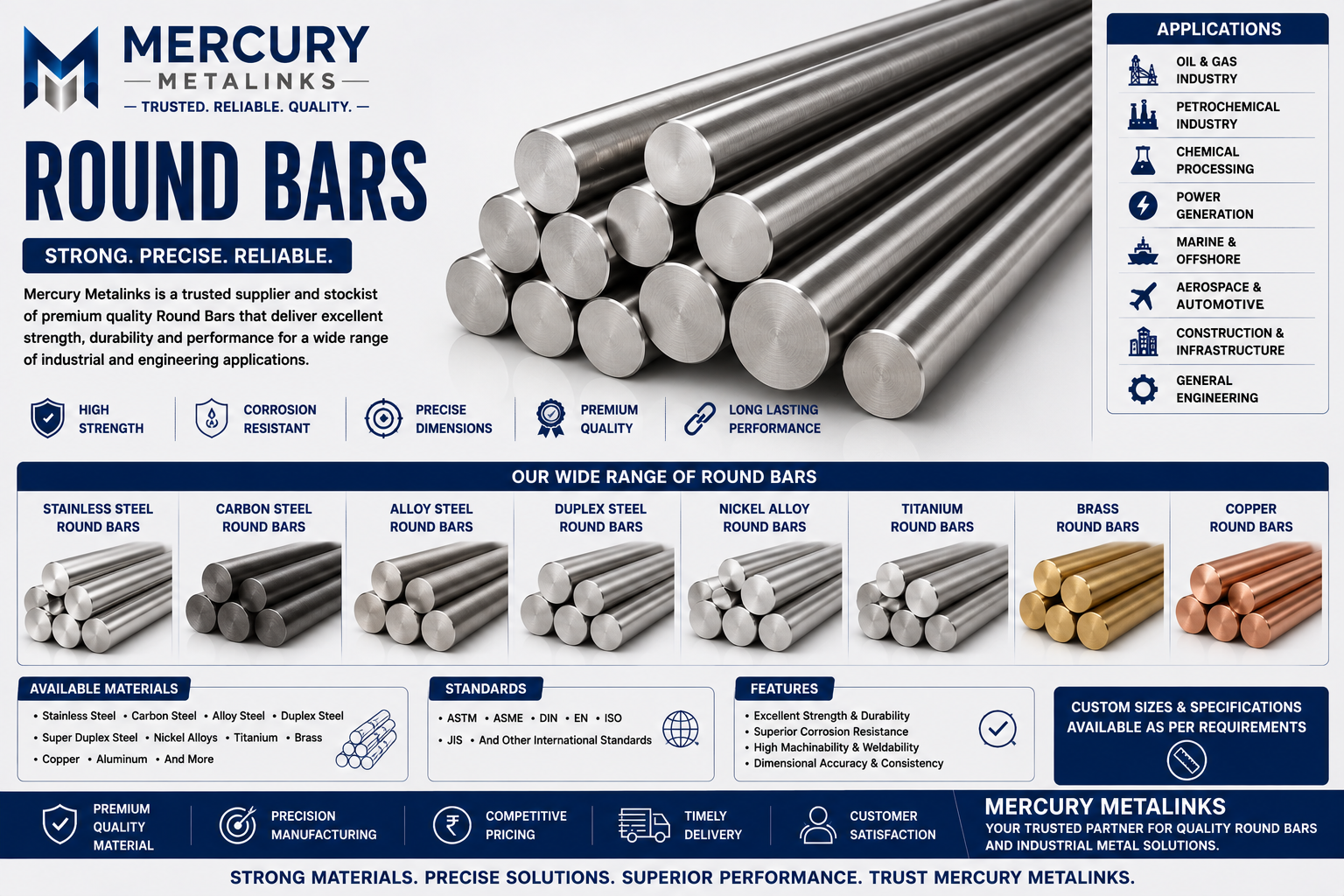 | ROUND BAR Round Bars – Mercury Metalinks Mercury Metalinks is a trusted supplier and stockist of premium-quality Round Bars, offering a comprehensive range of... View product → |
Verify the shipment before it enters production
A receiving check proves conformity only when the paperwork, markings and measurements point to the same physical bars. Treat an untraceable certificate as missing evidence, not as proof that the shipment is correct.
1. Match the purchase order to the mill test certificate: grade, governing standard, heat-treatment or supply condition, diameter, length, tolerance, straightness, surface condition and quantity. ASTM A29/A29M or ASTM A108 alone is not enough; record the specified grade and finish.
2. Trace every bundle to its heat or cast number. Check the tag, bar markings and certificate number, then photograph them before cutting. Reject a generic certificate that cannot identify the delivered heat.
3. Measure a sample across several bars with a calibrated micrometer, steel rule and straightedge or V-block setup. Check diameter, length, straightness, end condition and visible laps, seams, rust or grinding damage against the order. A tight diameter does not prove straightness or stable machining behaviour.
4. Compare the certificate’s chemistry, tensile strength, yield strength, elongation and hardness with the specified values. For alloy, heat-treated or safety-critical stock, use positive material identification or independent chemistry testing; hardness alone cannot confirm grade.
5. Quarantine discrepancies before production. Ask the metal round bar procurement team to obtain a corrected traceable certificate or written concession, and document any retest. A round bar supplier in Mumbai should resolve the variance before you machine, weld or distribute the material.
Frequently asked questions
How do you match round bar to the part?
Start with the part’s load path, operating environment, machinability and finished dimensions, then select the grade and diameter rather than choosing diameter alone.
Which round bar supply form reduces total work?
Choose bright, black or peeled bar according to the required surface finish, dimensional tolerance and machining allowance; the cheapest form can create more preparation work.
What should a round bar purchase specification include?
State the material grade, product standard, diameter, length, tolerance, surface condition, straightness, quantity, packing and required inspection or test documents.
How should procurement teams compare round bar costs?
Compare usable cost after machining allowance, offcuts, surface preparation, rejects, freight, inspection and lead-time effects—not only the quoted price per kilogram.
What should you check when round bar arrives?
Check heat or batch identification, diameter, length, straightness, surface condition, quantity, packing and the material certificate before releasing stock to production.