Choosing duplex steel on the word “corrosion resistant” is not enough: chloride concentration, temperature, pressure, joint design and fabrication controls determine whether it outperforms 316L, coated carbon steel or super duplex. By the end, you will have a practical test for grade selection, a document and inspection checklist, and a way to judge whether a Mumbai supplier can control the risks after the material leaves the mill.
Key takeaways
- Match duplex grade to chloride, temperature, pressure and service-life demands.
- Choose 2205, lean duplex or 2507 using performance and total-cost factors.
- Specify welding, heat-treatment and traceability controls before placing the purchase order.
- Verify heat numbers, mill certificates and grade before cutting or fabrication.
Start with the service conditions, not the word “duplex”
A chloride-rich service with evaporation, crevices, weld discoloration or poor drainage needs a materials decision based on temperature, chloride concentration, pressure, weld design, service life and fabrication method. Coastal Mumbai conditions make cleaning and crevice design procurement issues, not just alloy-selection issues.
Deposits under gaskets or supports can initiate pitting even when the bulk solution appears mild.
| Option | Choose it when | Main trade-off |
|---|---|---|
| 316L stainless steel | Chloride exposure and temperature are moderate, with straightforward forming and welding | Easier fabrication, but lower resistance to pitting and crevice corrosion |
| Lined or coated carbon steel | The lining or coating can be inspected, repaired and protected from mechanical damage | Lower initial alloy cost, but one defect can expose carbon steel to rapid corrosion |
| Duplex 2205 | You need higher chloride resistance and strength than 316L without the cost and fabrication demands of 2507 | Higher forming force, springback and welding controls than 316L |
| Super duplex 2507 | High chloride, elevated temperature or severe crevice exposure exceeds 2205 capability | Higher material price and tighter forming, welding and phase-control requirements |
For duplex steel for fabrication in Mumbai, 2205 is often the balanced choice for tanks, piping and structural process components when its qualified corrosion margin fits the service.
Choose super duplex only when the documented environment demands its higher pitting resistance; choose lined carbon steel when inspection access and coating integrity are stronger controls than alloy performance. Compare total installed and lifecycle cost, including fabrication, cleaning and failure risk, across duplex steel industrial applications—not just the per-kilogram quote.
Compare 2205, lean duplex and 2507 on performance and total cost
A 2507 quote is not automatically the lowest-cost choice: its corrosion margin can exceed the requirement while its forming, welding and inspection demands increase the installed cost. Compare PREN, strength, fabrication route and supply lead time before selecting a grade.
| Grade | Corrosion resistance | Strength and fabrication | Availability and price |
|---|---|---|---|
| Lean duplex, such as 2101 or 2304 | Lower PREN and molybdenum content; suitable for moderate chloride exposure, but less tolerant of pitting than 2205 | High yield strength; springback, work hardening and machining loads remain significant | Often cost-effective and available in common forms; price is usually below 2205 |
| 2205, UNS S31803/S32205 | Typical PREN around 34; a strong general choice for chloride-bearing process, coastal and marine service | About twice the yield strength of 300-series stainless; needs controlled forming, welding heat input, interpass temperature and post-weld cleaning | The broadest duplex stock range; mid-level material cost and the easiest grade to source in many product forms |
| 2507, UNS S32750/S32760 | PREN above 40; substantially better resistance to pitting and crevice corrosion | Highest strength and most demanding control of bending, welding, ferrite balance and intermetallic phases | Narrower stock availability, longer procurement risk and the highest material price |
For duplex steel procurement, compare total installed and lifecycle cost, not kilograms alone. A higher 2507 price can reduce wall thickness or extend service in severe duplex steel industrial applications, but unnecessary alloy content only adds fabrication and inspection cost. Confirm the required form, thickness, heat-treatment condition and standard before accepting a quotation.
Build fabrication controls into the purchase decision
Agree the fabrication controls in the purchase order before buying duplex steel for fabrication in Mumbai. A grade and kilogram price do not define a workable job: state the product form, thickness, UNS grade, applicable standard, heat-treatment condition and inspection records.
1. Approve the welding plan before release. Name the WPS and PQR, joint design, qualified process, filler metal, shielding and root-purge gas, maximum heat input, interpass temperature and acceptable ferrite-austenite balance. Require ferrite checks where the weld procedure or section thickness makes phase balance critical.
2. Define forming limits with the fabricator. Record the minimum bend radius, press-brake force, tooling, springback allowance and number of forming passes. For hot forming, specify the solution-annealing temperature range and rapid cooling method; uncontrolled heating can create harmful intermetallic phases.
3. Price machining from the actual grade and thickness. Agree carbide tooling, cutting speed, feed, coolant and tool-change rules. Duplex strength increases cutting loads and work hardening, so a 316L machining allowance cannot simply be copied.
4. Specify post-fabrication cleaning. Require dedicated stainless tools, protection from carbon-steel dust, weld-spatter removal, pickling and passivation, followed by thorough rinsing and drying. Record the chemicals and process time.
5. Require heat-number traceability through cutting, welding and final inspection. Include PMI after fabrication, consumable batch records, ferrite results and any solution-annealing or intermetallic-phase test reports. A supplier that cannot document these controls is quoting material, not a controlled fabrication route.
Verify grade, heat treatment and traceability before cutting
Do not cut duplex material until every piece carries a heat number that matches its mill certificate. For duplex steel procurement, specify the grade, product form, thickness, applicable product standard, heat-treatment condition and inspection requirements in the purchase order. “Duplex stainless” alone cannot prove suitability.
- Request an EN 10204 3.1 mill certificate showing chemical analysis, tensile and yield results, elongation, impact results where specified, solution-annealing condition and heat number.
- Match the certificate to the product form: ASTM A240 for plate, sheet and strip; ASTM A276 for bar and shapes; ASTM A790 for seamless or welded pipe.
- Confirm the grade by its UNS designation, such as S31803 or S32205 for 2205 and S32750 or S32760 for 2507. Do not treat 2205 and 2507 as interchangeable.
- Record heat-number transfer from plate, pipe or bar to each cut part, spool or fabricated component. Perform PMI after fabrication, using a calibrated instrument suitable for the grade.
- Obtain the WPS and PQR, welding-consumable certificates, interpass and heat-input records, solution-annealing records for hot-formed parts, and pickling, passivation and final inspection reports.
| Evidence | What it proves | What it cannot prove |
|---|---|---|
| Mill certificate | Heat chemistry, properties and treatment | Correct identity after cutting |
| PMI report | Alloy identification at tested points | Reliable grade separation with unsuitable calibration |
| Laboratory chemistry | Definitive composition check | Fabrication quality |
| WPS/PQR and weld records | Controlled welding variables | Parent-metal traceability without heat-number records |
Judge a Mumbai supplier by control of the whole job
A supplier who can quote 2205 plate but cannot control cutting, fabrication records and delivery coordination is a stockist, not a project partner. Choose a duplex steel supplier in Mumbai that can keep the specified grade, heat number and fabrication route connected from mill receipt to finished component.
Ask for evidence that the supplier will manage these points:
- A purchase order naming UNS S31803/S32205, S32750 or the selected lean duplex grade, product form, thickness, ASTM product standard and solution-annealed condition.
- Heat-number traceability from each plate, pipe or fitting to the mill certificate, including replacement-material controls if stock is split or cut.
- Coordination with the fabricator on WPS/PQR, approved consumables, purge-gas records, interpass temperature, ferrite checks and post-weld pickling.
- Cutting and machining controls that preserve identification, machining allowance and surface finish; rubbing, blunt tooling and carbon-steel contamination can damage a component that still passes a basic PMI scan.
- Inspection planning covering visual checks, dimensions, weld examination, PMI after fabrication and laboratory chemistry when the analyser cannot reliably separate grades.
- Delivery protection, packing and documentation that prevent mixed heat numbers, wet packaging, unauthorised substitutions or missing certificates at site.
Do not accept “duplex stainless” as the complete offer description. Mercury Metalinks becomes useful in duplex steel procurement when it can answer these questions before dispatch, not merely confirm that material is available. A higher per-kilogram quote can still win if it prevents rework, failed inspection or an untraceable replacement.
Related products
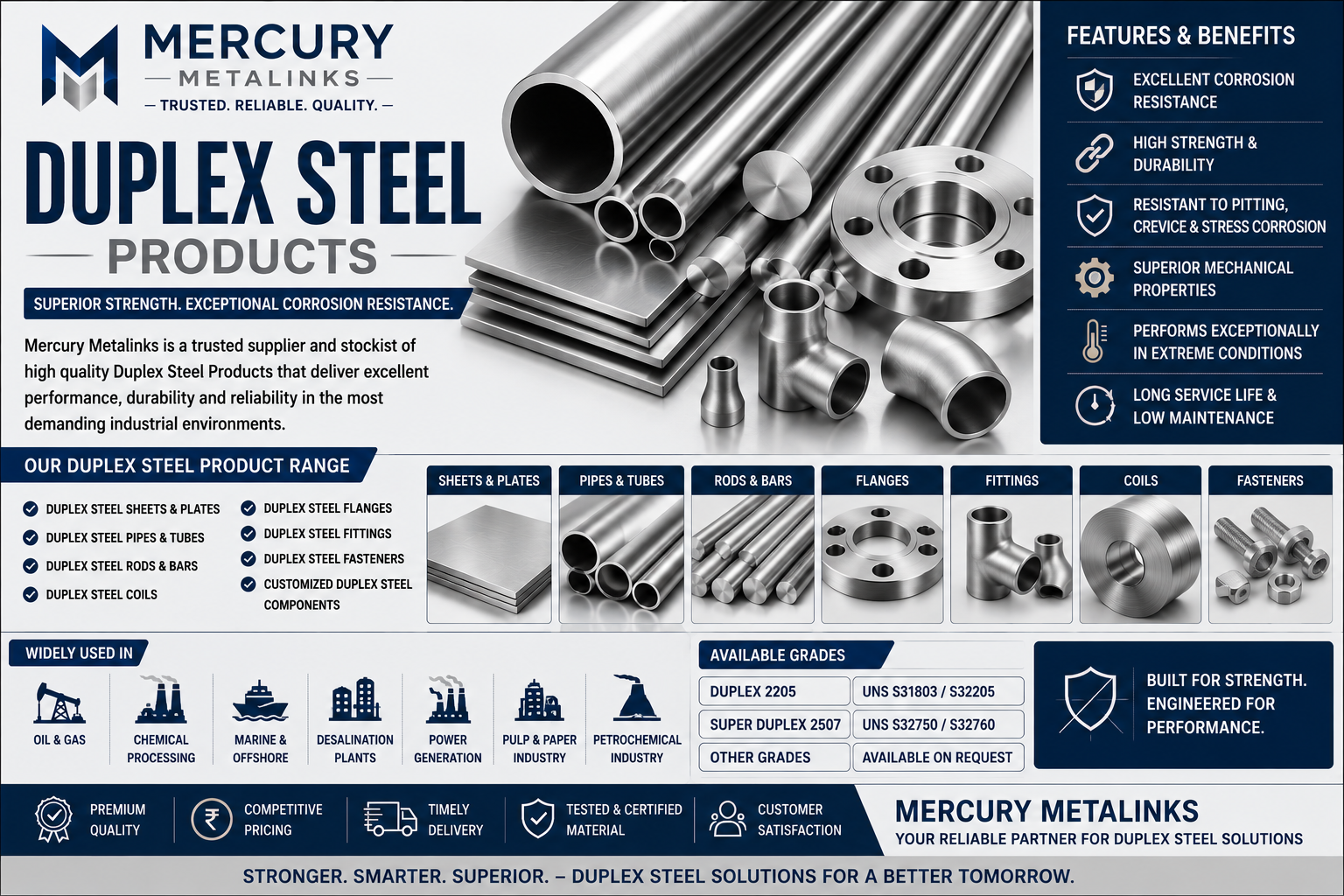 | DUPLEX STEEL Products – Mercury Metalinks Mercury Metalinks is a trusted supplier and stockist of premium-quality Duplex Steel Products, offering a comprehensive... View product → |
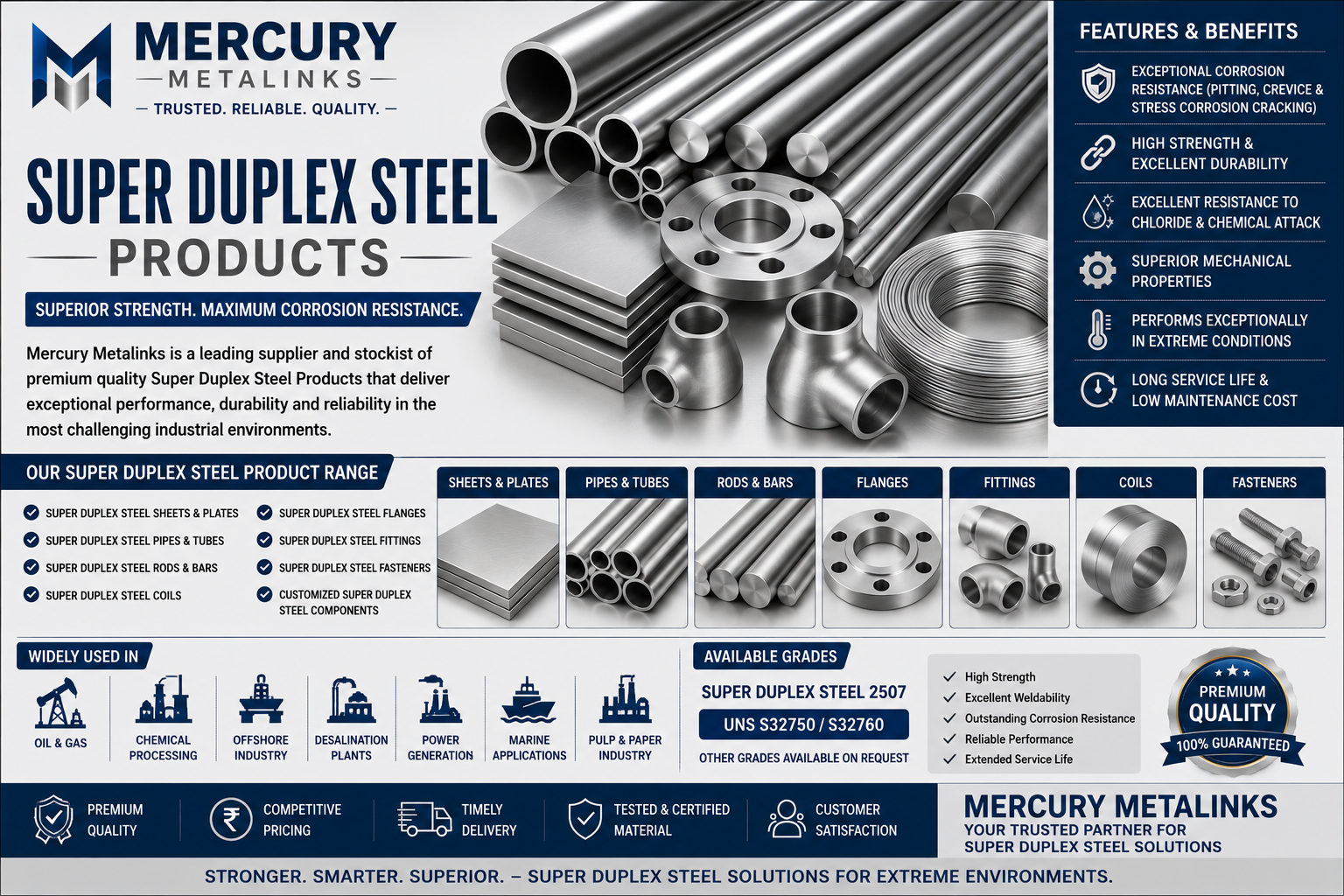 | SUPER DUPLEX STEEL Products – Mercury Metalinks Mercury Metalinks is a trusted supplier and stockist of premium-quality Super Duplex Steel Products, offering a... View product → |
Frequently asked questions
How should you choose duplex steel for a Mumbai fabrication project?
Start with chloride concentration, temperature, pressure, crevice exposure, weld design, drainage and required service life—not the alloy name alone.
What is the difference between 2205, lean duplex and 2507?
Lean duplex reduces alloy cost for less severe duties, 2205 covers many chloride-exposed applications, and 2507 suits higher corrosion and temperature demands.
Which fabrication controls matter when procuring duplex steel?
Specify heat input, interpass temperature, shielding gas, weld consumables, ferrite balance, pickling or passivation and post-weld inspection requirements.
What should you verify before cutting duplex steel?
Check the grade, heat number, mill test certificate, chemical analysis, mechanical results, solution-annealing condition and traceability markings.
How do you assess a duplex steel supplier in Mumbai?
Check whether the supplier controls material sourcing, documentation, cutting, packing, delivery and technical support across the complete job.