A forged fitting is not defined by its shape alone: the alloy, forming route, heat treatment, machining, inspection, and traceability determine whether it suits a pressure system. By the end, you will be able to follow each manufacturing stage, distinguish local production from sourced stock, and write a purchase specification that a Mumbai supplier can fulfil without guesswork.
Key takeaways
- Start with certified billet and verify its heat number.
- Confirm fitting size, pressure class, material, and connection type.
- Request heat-treatment records, inspection reports, and material certificates.
- Choose forged fittings for compact, high-pressure threaded or socket-weld connections.
From certified billet to a finished forged fitting
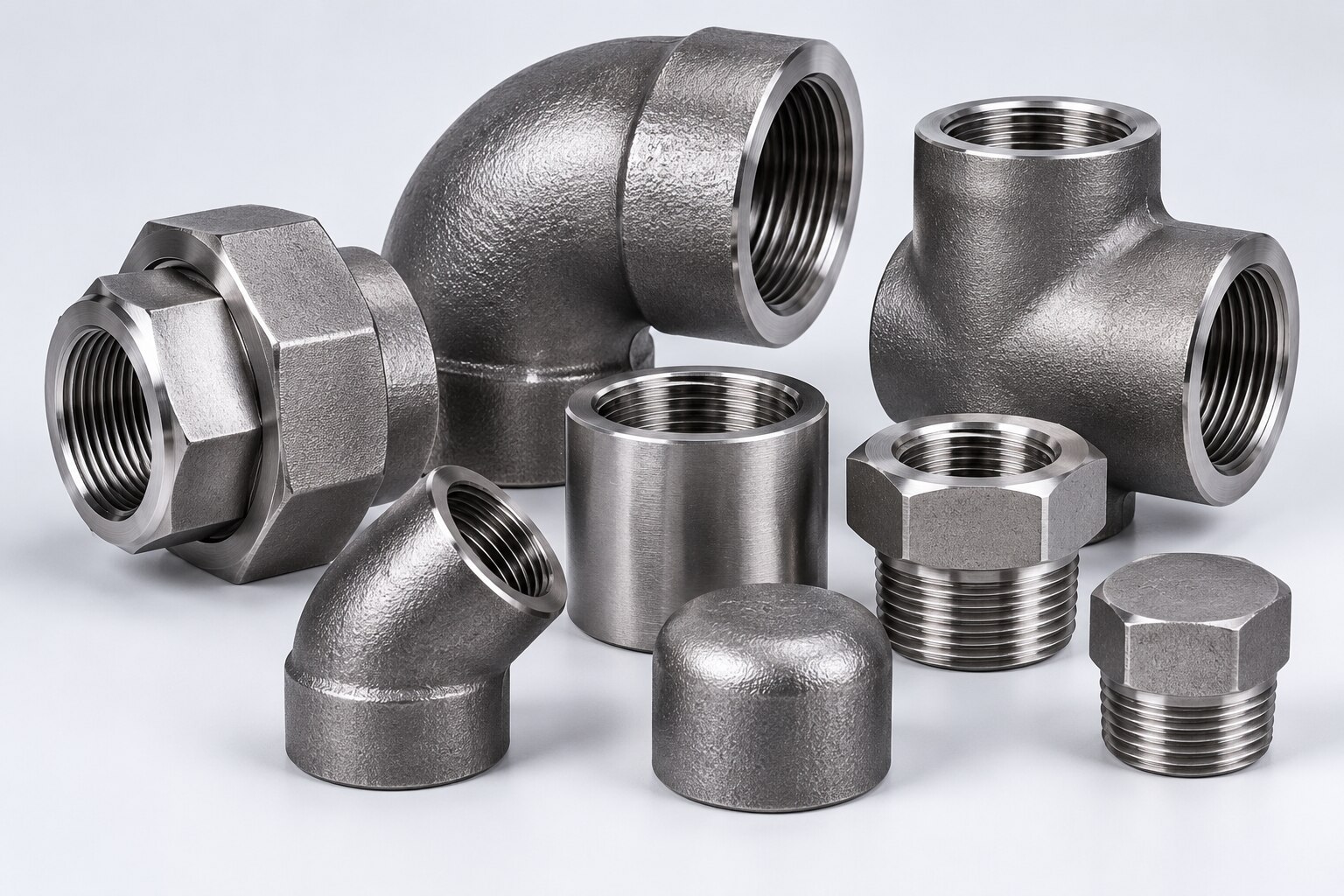
A forged fitting starts as certified bar or billet, not as an unidentified piece of metal. The forged fitting manufacturing process converts that stock into a pressure-containing elbow, tee, coupling, socket, union, or boss through controlled forming, heat treatment, machining, and inspection.
1. Select the alloy and verify the mill certificate. ASTM A105 covers carbon-steel forgings, ASTM A182 covers stainless and alloy-steel forgings, and ASTM A350 covers specified low-temperature service. Record the heat number before cutting.
2. Cut the bar or billet to a calculated weight. The cut pieces must retain the original heat number through tags, transfer records, and production paperwork.
3. Heat the stock in a controlled furnace to the forging temperature specified for that alloy. There is no universal temperature: insufficient heat can prevent die filling, while excessive heat increases oxidation, scale, and grain damage.
4. Upset, extrude, or pierce the heated piece before placing it in the forming dies. Small fittings may need several operations rather than one closed-die blow.
5. Close the dies to create the outside profile, then trim flash and remove scale. Inspect the forging for laps, cracks, underfill, and visible surface damage.
6. Apply the specified heat treatment, such as normalising, quenching and tempering, or solution annealing. Keep the furnace cycle and cooling records with the heat number.
7. Machine the bore, socket, faces, threads, and bevels to the required dimensions. Machining also removes forging allowance and prepares the connection surfaces.
8. Complete dimensional, visual, hardness, chemical, and any specified non-destructive examinations. Mark the fitting with size, rating, material, standard, and heat number, then protect threads and pack it with matching documents.
A Mumbai supplier may stock fittings forged by an approved local or outside unit. Accept the product only when the marking, tag, packing list, and material certificate reconcile.
How heat and dies create the fitting’s strength and shape
A fitting gains its pressure strength before machining: controlled heat lets the billet deform without cracking, while the dies direct metal around the required bore, branch, socket, or thread zone. The forging temperature must match the selected alloy; there is no safe universal temperature.
Excess heat enlarges grains and increases oxidation, while insufficient heat causes cracks, incomplete filling, and excessive forming force.
To understand how forged fittings are made in Mumbai, follow the purpose of each operation:
- Upsetting shortens and thickens heated bar, building extra metal for couplings, unions, bosses, and other pressure-bearing sections.
- Extrusion pushes heated stock through a die to form a controlled bore or tubular preform, reducing the amount of later machining.
- Closed-die forging squeezes the preform between shaped dies so elbows, tees, sockets, and other profiles fill accurately with continuous grain flow.
- Trimming removes the flash around the die parting line; descaling removes heat-formed oxide before heat treatment and final machining.
Cold forging avoids scale and can deliver tight dimensions, but work hardening raises forming loads, limits section size and complexity, and can leave residual stress. Simple machining from bar gives excellent dimensional accuracy, yet cuts away material and leaves the original bar grain pattern rather than directing it through the fitting’s shape.
| Option | Main advantage | Main limitation |
|---|---|---|
| Hot forging | Grain flow and efficient material use | Scale and thermal distortion require control |
| Cold forging | Clean surface and close dimensions | High loads and limited geometry |
| Machining from bar | Precise final dimensions | More waste and no shaped grain flow |
What Mumbai manufacturing and stock routes mean for traceability
A Mumbai supply route does not automatically mean every operation happened locally. A forging unit in or around Mumbai may cut, heat, upset, extrude, die-forge, trim, heat-treat, machine, inspect, mark, and pack the fitting, while an approved mill supplies the certified bar or billet.
A stockist may instead hold finished fittings made by an approved forging unit elsewhere.
| Route | Work performed | Evidence to request |
|---|---|---|
| Local forging unit | Forms and finishes the fitting in Mumbai | Forging-unit name, process route, heat-treatment record, inspection report |
| Approved mill plus Mumbai stockist | Produces the bar or billet; the stockist stores and supplies finished fittings | Mill material certificate, supplier invoice or packing record, matching fitting marking |
| Outside forging unit through Mumbai supplier | Manufactures and tests the fitting before shipment | Manufacturer name, product certificate, dimensional report, and traceable packing list |
Use the purchase order to separate the fitting standard from the material grade. ASME B16.11 defines dimensions and ratings; it does not prove ASTM A105 carbon steel or ASTM A182 stainless or alloy steel.
For a forged fittings supplier in Mumbai, verify these release details before acceptance:
- Match the heat number on the fitting, tag, packing list, and material test certificate.
- Check chemistry, tensile strength, yield strength, elongation, hardness, and heat treatment against the specified material standard.
- Confirm dimensional inspection, visual examination, marking, and any ordered magnetic-particle, penetrant, ultrasonic, or hardness testing.
- Reject “forged equivalent” wording when the governing product standard is absent.
Mercury Metalinks can be assessed on the same evidence: a certificate without matching product marking is not traceability.
Related product
 | FORGED FITTINGS Mercury Metalinks Mercury Metalinks is a trusted supplier and stockist of premium-quality Forged Fittings, offering a comprehensive range of... View product → |
How to specify size, class, material, and connection before ordering
A “3000 class” mark is not a complete purchase specification. Pressure-temperature derating depends on the material and piping code, so do not infer the allowable pressure from the class number alone.
1. State the fitting standard and edition, such as ASME B16.11, then identify the item: elbow, tee, coupling, union, socket, or threaded adapter. ASME B16.11 covers forged socket-welding and threaded fittings from NPS 1/8 through NPS 4.
2. Give the nominal pipe size, pressure class, end connection, and bore requirement. Specify socket-weld or threaded ends, thread form where applicable, and the pipe schedule or wall thickness that the fitting must accept. Class 3000 and 6000 commonly apply to socket-weld fittings; threaded fittings also use Class 2000.
3. Name the material standard and grade separately from the fitting standard. Examples include ASTM A105 carbon steel and ASTM A182 stainless or alloy steel. For low-temperature service, specify ASTM A350 grade, impact-test temperature, hardness limit, and required heat-treatment condition; an A105 certificate is not an equivalent substitute.
4. Add inspection and documentation requirements: material certificate, heat-treatment record, dimensional inspection, non-destructive testing, and the governing project inspection plan.
5. Require the heat number on the fitting, tag, packing list, and certificate to match. A certificate without matching product marking does not provide traceability, even when a bar or billet was divided into several fittings.
These details make industrial forged fitting specifications usable when you buy forged fittings in Mumbai.
Where forged fittings fit better than butt-weld fittings
Choose socket-weld or threaded fittings when compact, small-bore connections matter more than uninterrupted flow area. Choose butt-weld fittings when you need a continuous pipe bore, larger sizes, and a fully welded joint.
| Option | Installation | Bore and wall thickness | Usable pipe size |
|---|---|---|---|
| Socket-weld forged | Insert the pipe into the specified socket depth, leave the required expansion gap, and apply a qualified fillet weld. | The socket shoulder and internal transition interrupt the bore; the fitting has a thick forged body and machined socket. | ASME B16.11 covers NPS 1/8 through NPS 4; common socket-weld classes are 3000 and 6000. |
| Threaded forged | Screw the pipe or nipple into the specified thread, using the correct sealant and engagement. Match ASME B1.20.1 NPT only with NPT; do not substitute BSPT or parallel threads. | Thread roots reduce the effective bore, while the fitting retains a heavy pressure-containing wall. | ASME B16.11 covers NPS 1/8 through NPS 4; threaded classes include 2000, 3000, and 6000. |
| Butt-weld | Bevel, align, preheat where required, and complete a qualified groove weld. | The fitting follows the pipe schedule, giving a smoother, near-continuous bore after welding, with wall thickness matched to the piping design. | Preferred for larger pipe and high-flow lines beyond the usual forged-fitting range. |
A matching NPS and class does not make connection types interchangeable. Your industrial forged fitting specifications must state the end connection, material grade, bore or schedule, standard edition, and temperature-based rating basis; class alone is incomplete.
Frequently asked questions
How are forged fittings manufactured?
Manufacturers cut certified bar or billet, heat it, form it in dies, heat-treat it, machine connection surfaces, and inspect the finished fitting.
How does forging improve fitting strength and shape?
Controlled heat and die pressure shape the metal while maintaining a continuous grain flow around the pressure-containing form.
What traceability documents should you request in Mumbai?
Ask for the material test certificate, heat or batch number, heat-treatment record, dimensional inspection report, and applicable test certificates.
What information is needed to order an industrial forged fitting?
Specify nominal size, pressure class, material grade, fitting type, connection such as threaded or socket-weld, standard, quantity, and delivery requirements.
When are forged fittings better than butt-weld fittings?
Use forged fittings for compact high-pressure connections, small-bore piping, threaded systems, and socket-weld assemblies; use butt-weld fittings for larger bore welded runs.