The right connection depends on more than pipe size or purchase price: pressure, temperature, fluid, vibration, inspection access, and future maintenance all change the answer. By the end, you will be able to choose between welded and threaded joints, specify the fitting accurately, and compare suppliers using installation effort, documentation, and lifecycle risk.
Key takeaways
- Choose butt welds for demanding pressure, temperature, corrosion, and cyclic service.
- Choose threaded fittings for smaller, lower-risk lines needing simpler installation.
- Match NPS, schedule, material grade, pressure class, end type, and standards before ordering.
- Compare Mumbai suppliers on traceability, certificates, stock accuracy, and technical support.
When should you choose butt-weld fittings instead of threaded fittings?
Choose butt-weld fittings for larger-diameter, high-pressure, high-temperature, corrosive, toxic, flammable, sanitary, erosive, or cyclic process lines where a continuous pressure boundary and low leakage exposure matter. For butt weld fittings or threaded fittings in Mumbai, service conditions—not catalogue labels or nominal size alone—set the starting point.
| Option | Best fit | Main limitation |
|---|---|---|
| Butt-weld fittings | Critical process, steam, fuel, hydrocarbon, sanitary, and cyclic lines | Requires controlled welding and inspection |
| Threaded fittings | Small, accessible instruments, vents, drains, and selected air or water utilities | Vulnerable to vibration, thermal cycling, corrosion, and repeated maintenance |
| Socket-weld fittings | Some small-bore lines needing no exposed pipe threads | Socket gap, insertion depth, drainage, and code restrictions require control |
Butt-welded joints remove the internal thread crevice, reducing dead-leg, moisture retention, and contamination concerns. They demand accurate alignment, root-gap and bevel control, a qualified welding procedure and welder, compatible consumables, purging where specified, and weld inspection; the installation effort is higher.
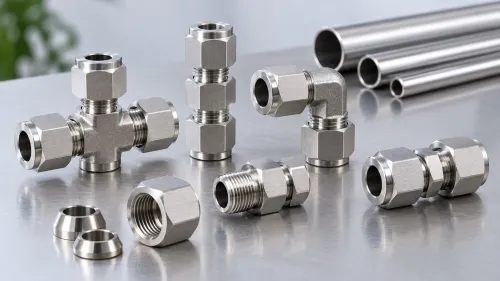
Threaded fittings suit noncritical services when ASME B31.3, ASME B31.1, and the project specification permit them and future disassembly matters. Vibration can loosen them, thermal cycling can open leak paths, corrosive fluids can attack thread crevices, and larger diameters become difficult to assemble reliably.
For piping fittings for industry, compare butt weld versus threaded fittings on leakage risk, inspection access, maintenance, and lifecycle cost. Choose the threaded option only when the code and project specification accept it.
How do installation, leakage, and maintenance differ on site?
On a Mumbai worksite, threaded fittings are easier only when the line is small, accessible, noncritical, and allowed by the governing code. Butt-weld fittings take more control but usually provide fewer leak points and safer long-term containment.
| Option | Installation | Leakage and maintenance |
|---|---|---|
| Butt weld | Cut, bevel, align, set the root gap, tack, and weld to an approved procedure. ASME Section IX requires separate procedure and welder qualifications; control consumables, purge gas where required, NDT, heat treatment, and rework. | No internal thread crevice and a continuous pressure boundary, but hot-work permits, fire restrictions, poor access, shutdown limits, and field modification complicate repairs. |
| Threaded | Cut or form clean threads, confirm NPT or BSP compatibility, select fluid- and temperature-compatible sealant or tape, control tightening, and leave wrench access. | Threads create a leak path, root stress concentration, sealant-compatibility risk, and a moisture-retaining crevice. Retightening or replacement is easier, but vibration and corrosion increase maintenance. |
For piping fittings for industry, compare installed and lifecycle effort rather than purchase price. Use butt welds where leak exposure, cyclic loading, contamination, or pressure makes rework costly; use threads for accessible vents, drains, instruments, and permitted utilities. Sanitary lines require smooth bores, drainability, validated cleaning, and dead-leg control, so ferrules often outperform threads.
Small-bore socket-weld fittings avoid exposed threads but require controlled insertion gap and drainage. Flanges suit hygienic disassembly or frequent dismantling where wrench access and hot work are restricted.
What must match before you order elbows, tees, reducers, or caps?
A correct nominal size does not guarantee a correct fit. For every 90-degree or 45-degree elbow, tee, reducer, cap, coupling, or branch connection, specify:
- Nominal pipe size and outside diameter
- Schedule or wall thickness
- Material specification and ASTM grade
- Seamless or welded construction
- End preparation, including bevel
- Design temperature, pressure, and applicable code basis
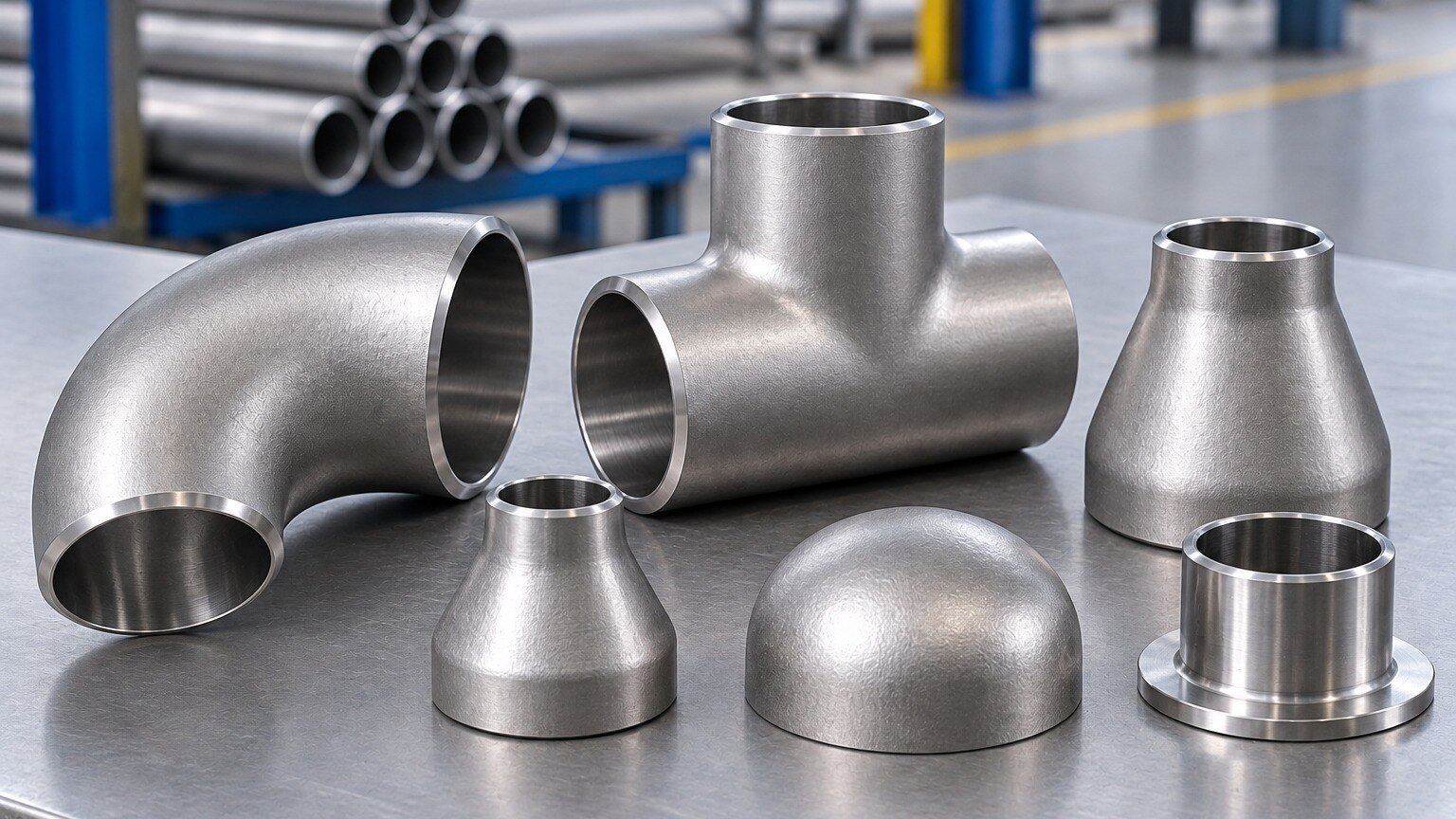
ASME B16.9 covers factory-made wrought butt-weld elbows, tees, reducers, caps, and return bends from NPS 1/2 through NPS 48. Do not use ASME B16.11 dimensions to select a butt-weld fitting: B16.11 covers forged threaded and socket-weld fittings.
Match the fitting wall and bevel to the pipe schedule, or define a reducer, transition, or weld detail where they differ. A mismatch creates an internal step, poor fit-up, or inadequate weld land.
For threaded industrial fittings in Mumbai, specify NPT to ASME B1.20.1 or the applicable BSPT or BSPP standard. NPT and BSP are not interchangeable.
| Standard | Connection covered | Class or scope |
|---|---|---|
| ASME B16.9 | Factory-made wrought butt-weld fittings | Dimensions; not a universal pressure rating |
| ASME B16.11 | Forged threaded fittings | Class 2,000, 3,000, or 6,000 |
| ASME B16.11 | Forged socket-weld fittings | Class 3,000, 6,000, or 9,000 |
Class is not a universal bar rating across materials and temperatures. Where flanges connect the line, check ASME B16.5 or B16.47. State the temperature-pressure basis when ordering butt weld fittings or threaded fittings in Mumbai.
How do fluid, material, and operating conditions change the selection?
A dimensionally correct fitting can still fail in service. Choose between butt weld versus threaded fittings only after checking the fluid, material, pressure, temperature, vibration, thermal cycling, inspection access, and future maintenance against ASME B31.3, ASME B31.1, and the project specification.
- Select carbon steel, stainless steel, or a specialty alloy for the fluid chemistry and required corrosion allowance. Check galvanic compatibility at dissimilar-metal joints, erosion from high-velocity solids or steam, design pressure, temperature, toxicity, and flammability. Do not weld mismatched alloys without a qualified welding procedure, compatible consumables, and qualified personnel.
- Prefer welded joints for chemical process, steam, fuel, and critical hydrocarbon lines where a continuous pressure boundary, fewer leak paths, and no internal thread crevice matter. Threaded joints can suit accessible instrument take-offs, drains, vents, and selected utility lines when the code permits disassembly.
- Confirm that thread sealant withstands both the fluid and operating temperature. Thread crevices trap moisture, chemicals, and product, making them poor choices for corrosive, sanitary, or contamination-sensitive service.
- Treat “SS elbow” and “carbon-steel tee” as incomplete specifications. State the grade, schedule, construction, end type, and temperature-pressure rating; sanitary food and pharmaceutical lines also need smooth, cleanable internal surfaces.
- Check compressed-air and water systems for code limits, pressure, corrosion, and maintenance—not just apparent mild service.
For industrial fittings in Mumbai, keep carbon-steel stock dry to prevent flash rust, and segregate it from stainless fittings to avoid carbon-steel contamination. These handling controls support, but do not replace, fluid-specific selection of piping fittings for industry.
How should you compare a Mumbai supplier before placing the order?
Choose the supplier that can document suitability, not the one that merely shows “available” beside an elbow. A butt weld fittings supplier in Mumbai should quote against your complete technical description and delivery requirement.
Put these details in the purchase order:
- Fitting standard, nominal size, schedule or class, material specification and grade
- Seamless or welded construction where relevant, end preparation, and heat-treatment requirement
- Quantity, project quantity, required delivery date, and inspection documents
- Heat or batch traceability, material test certificates, dimensional inspection results, and EN 10204 Type 3.1 certification when specified
Before paying, verify actual stock rather than relying on a catalogue listing. Ask for the confirmed lead time, packaging method, storage condition, and the supplier’s response time for shortages or replacements. Mumbai’s humidity and salt exposure make wet-stored carbon steel vulnerable to flash rust; keep stainless fittings separated from carbon-steel contamination.
Compare the installed cost, not just the fitting price:
| Cost area | Butt-weld fitting | Threaded fitting |
|---|---|---|
| Equipment and labour | Welding machine, consumables, purging, qualified welders | Threading tools, sealant, and assembly labour |
| Quality and controls | Inspection, non-destructive testing, post-weld treatment, hot-work controls | Tightening control, sealant compatibility, and leak rework |
| Lifecycle impact | Fewer leak points but harder future access | Faster disassembly but greater leak and maintenance exposure |
Mercury Metalinks can be compared with other industrial fittings in Mumbai suppliers when it provides the specified fitting, traceability, inspection records, and delivery commitment; availability alone proves nothing.
Related product
 | BUTT-WELD FITTINGS Mercury Metalinks Mercury Metalinks is a trusted supplier and stockist of premium-quality Butt-Weld Fittings, offering a comprehensive range of... View product → |
Frequently asked questions
When should you choose butt-weld fittings instead of threaded fittings?
Choose butt-weld fittings for larger-diameter, high-pressure, high-temperature, corrosive, toxic, flammable, sanitary, erosive, or cyclic process lines where a continuous pressure boundary and low leakage exposure matter. Threaded fittings suit smaller, lower-risk services where installation access and future disassembly outweigh the benefits of a welded joint.
How do installation, leakage, and maintenance differ on site?
Butt-weld fittings require bevel alignment, qualified welding, shielding where specified, inspection, cleaning, and sometimes heat treatment, but they produce a compact joint with low leakage exposure. Threaded fittings install faster without welding equipment, yet require correct engagement, sealant selection, tightening, and periodic checks for loosening, galling, or thread corrosion.
What must match before ordering elbows, tees, reducers, or caps?
Confirm nominal pipe size, outside diameter, wall thickness or schedule, fitting geometry, end preparation, material grade, pressure-temperature rating, dimensional standard, and corrosion allowance. Check whether the line requires a long-radius elbow, concentric or eccentric reducer, equal or reducing tee, and matching weld bevel.
How do fluid, material, and operating conditions change the selection?
Review fluid toxicity, flammability, solids content, corrosiveness, cleanliness, temperature, pressure, flow velocity, vibration, and thermal cycling. Select compatible materials and joining methods, then verify the rating at the actual operating temperature rather than using the room-temperature pressure alone.
How should you compare a Mumbai piping-fittings supplier before ordering?
Ask for stock confirmation, heat or batch traceability, material test certificates, dimensional compliance, applicable inspection reports, delivery commitments, and clear substitution rules. A suitable butt weld fittings supplier in Mumbai should also identify the exact grade, schedule, standard, and end preparation on its quotation.