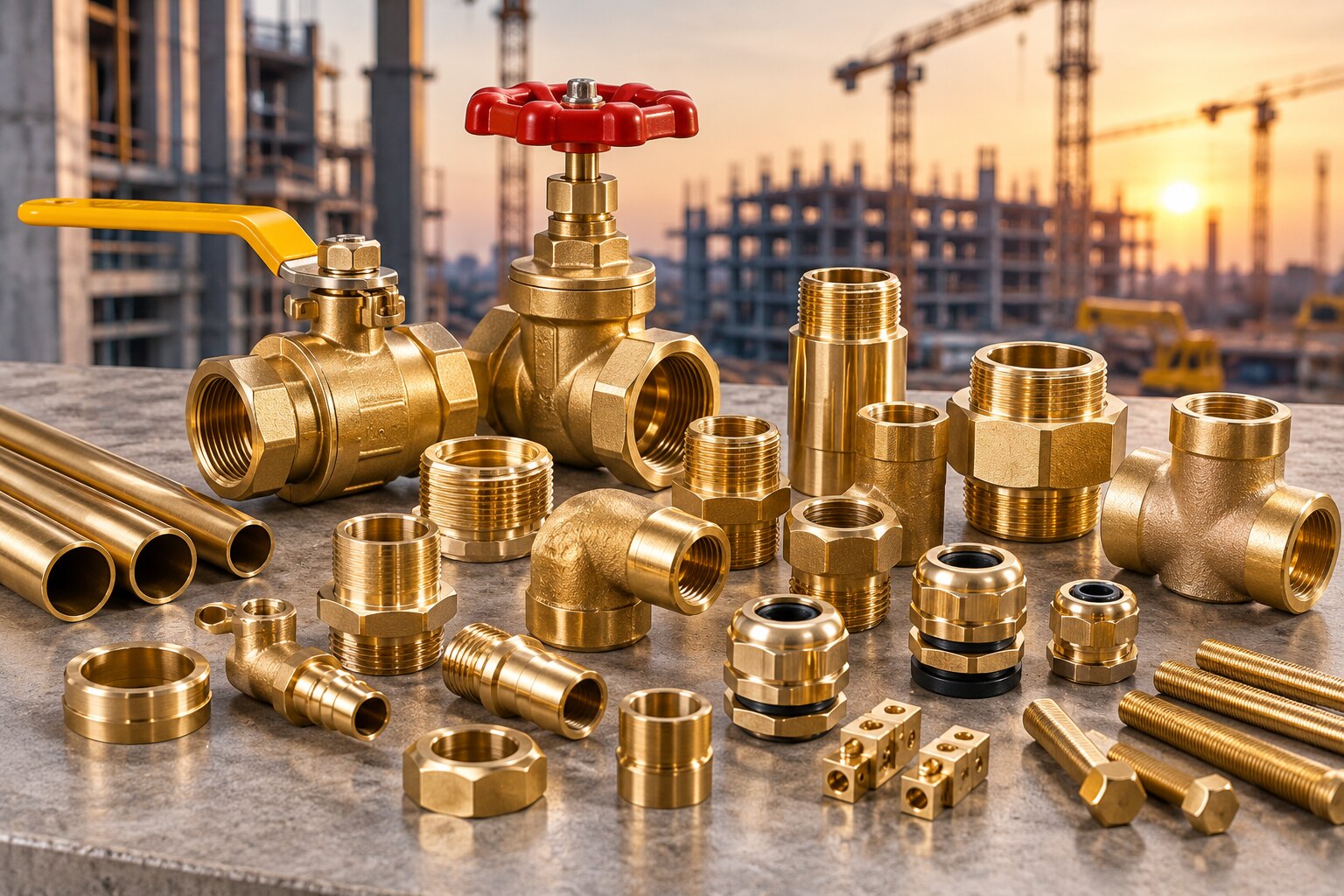
The right brass choice depends on the finished part, not on a supplier’s generic label. By checking the operation, service environment, alloy designation, temper and finished dimensions, you can specify stock that forms, machines and joins without paying for unusable material or discovering that it lacks allowance.
Key takeaways
- Specify the UNS alloy, not only “free-cutting brass.”
- Match temper to machining, forming, threading or bending requirements.
- Add machining allowance before choosing brass stock dimensions.
- Reject ordinary brass when seawater or aggressive joining conditions apply.
Which brass grades match the part you need to make?
The answer to which brass grade and size for fabrication starts with the part’s operation and service environment, not its colour. “Free-cutting brass” is a trade name, not a precise alloy; require the quotation to identify C36000 or another UNS designation.
| Option | Main characteristic | Best fit |
|---|---|---|
| C36000 | Lead-bearing, free-machining brass | Turned bushes, glands, adapters, valve parts and threaded fittings |
| C26000 | Nominally 70Cu–30Zn; highly formable | Sheet work, bending, spinning and drawing |
| C28000 | Muntz metal; stronger, less formable | Larger fabricated sections and warm-forming work |
| C38500 | Architectural or free-machining brass | Machined architectural hardware and shapes |
| C46400 | Naval brass with tin; stronger marine resistance | Coastal or seawater exposure where strength matters |
| CW602N or another lead-free/DZR alloy | Controls dezincification or lead exposure | Water-service parts where the specification requires it |
C36000 is the practical first choice for efficient machining, but its lead content makes it unsuitable where lead restrictions, fusion welding or severe hot forming apply. Choose C26000 for substantial forming; choose C46400 when marine exposure outweighs maximum machinability. Use CW602N when dezincification-resistant performance is specified.
For C36000-family rod, bar and shapes, check ASTM B16. Still state the temper, dimensions, tolerances and required mill certificate or chemical test report; the standard alone does not complete the purchase specification.
How should the fabrication operation determine the alloy and temper?
Choose the alloy by the operation that removes or moves the most metal; size the stock afterward. For anyone asking which brass grade and size for fabrication, this process-first method prevents a machinable bar from being forced into a forming job.
| Operation | Alloy and temper | Selection reason |
|---|---|---|
| Turning, drilling, tapping or milling | C36000, temper stated on the order | Free-cutting chips and commonly cited machinability rating of 100 against the benchmark; poor choice for fusion welding |
| Bending, spinning or deep drawing | C26000, annealed for severe reduction | Nominally 70Cu–30Zn; annealed stock forms more easily because recovery stresses are reduced |
| Light forming needing shape retention | C26000 half-hard or hard | Better dimensional stability and lower spring-back after forming |
| Small joined assembly | C26000 or C36000 with brazing or silver brazing | Practical alternative to fusion welding when the filler and joint design suit the service |
Select C36000 for bushes, glands, adapters and threaded fittings when chip control dominates. Do not use it for welded fabrication where its lead content and zinc loss create problems. Choose C26000 for substantial cold forming, then specify annealing if the reduction would crack half-hard or hard stock.
Brass welding needs local exhaust ventilation and controlled heat input: zinc can vaporise, produce fumes, cause zinc loss and contribute to porosity. Brazing or silver brazing avoids many of those difficulties, but still requires ventilation and a documented filler-metal procedure.
Polishing and colour are finish decisions, not proof of alloy identity. “Yellow brass” is inadequate; require the UNS designation or a chemical test report from a brass supplier in Chennai, including when the enquiry says brass for fabrication in Chennai.
How do you calculate the correct brass stock size?
Order the smallest standard section that leaves a clean allowance for the finished part. Specify brass by product form and controlling dimension, not by a vague “size” or nominal inch label.
1. Specify sheet or plate as thickness × width × length; specify round bar by diameter; hex bar by across-flats dimension; flat bar by thickness × width; and tube by outside diameter × wall thickness.
2. Separate nominal pipe size from measured dimensions. A 25 mm tube can mean 25 mm outside diameter, while a fitting may be sold as a nominal pipe size; request the actual OD, ID and wall thickness.
3. Choose round bar larger than the finished bush OD so facing, boring and turning remove scale or distortion and leave clean surfaces. For a bracket, select sheet thick enough for the load and bend radius, then allow for bend deduction and spring-back.
4. Select handrail tube by OD and wall thickness, not by a nominal pipe label. Add only the allowance needed for facing, cutting kerf, straightening, trimming and machining; oversized brass raises material cost, cutting time and distortion risk.
For brass sizes in Chennai, send an enquiry in this format: alloy and temper; product form; nominal dimensions; tolerance; quantity; required cut length; surface condition; applicable standard; and test-document requirement. Example: “C36000 half-hard round bar, 32 mm diameter, ±0.10 mm, six pieces at 250 mm cut length, mill test certificate required.”
When do water, seawater and joining conditions rule out ordinary brass?
Check the service before confirming the grade. Hot, oxygenated or chloride-bearing water can dezincify ordinary brass, leaving a porous, weakened copper-rich surface. For water-handling parts, compare ordinary brass with dezincification-resistant CW602N.
| Grade | Advantage | Limitation |
|---|---|---|
| C36000 free-machining brass | Excellent turning and threading | Poor choice for exposed seawater or fusion welding |
| CW602N DZR brass | Resists dezincification in specified water service | The designation alone does not prove potable-water approval |
| C46400 naval brass | Better strength and marine resistance than free-cutting brass | Not interchangeable with C36000 for tooling or forming |
CW602N still requires verification of the finished product, manufacturing route, and required national or project standard. Do not treat its designation as potable-water approval.
Before choosing brass for fabrication in chennai, check for:
- Stagnant water, ammonia or acids, which can accelerate attack.
- Crevices and poor drainage, where corrosive liquid remains trapped.
- Galvanic contact with stainless steel, carbon steel or aluminium; isolate dissimilar metals and control moisture.
For coastal or seawater-adjacent service, C46400 is more defensible than ordinary free-machining brass, but its forming and machining behaviour differs substantially.
If fusion welding would cause unacceptable zinc loss, use a documented brazing or soldering procedure. Confirm operating temperature, filler compatibility and extraction ventilation; zinc vapour can create harmful fumes, porosity and unstable joints.
What should you send a Chennai brass supplier before requesting a quote?
Send a brass supplier in Chennai a specification, not “brass rod” or “brass for fabrication in Chennai.” C26000 sheet, C36000 round bar and CW602N water-service components differ in forming, machining and compliance requirements.
- UNS alloy designation: C26000, C36000, CW602N or another specified grade.
- Product form: sheet, plate, round bar, hex bar, flat bar or tube.
- Nominal dimensions: thickness × width × length for sheet; diameter for round bar; across-flats for hex bar.
- For tube, state OD, ID and wall thickness separately, and identify each dimension as nominal or actual.
- Temper: annealed, half-hard, hard or the required temper designation.
- Quantity, required cut lengths and number of pieces.
- Dimensional tolerance for thickness, diameter, length and straightness.
- Surface condition: mill finish, polished, pickled or another specified finish.
- Applicable standard, such as ASTM B16 for C36000-family rod, bar and shapes.
- End use and joining method: turning, bending, brazing, soldering or welding.
- Required documents: mill test certificate, chemical test report or neither.
This detail lets Mercury Metalinks, or any comparable industrial brass stockist in Chennai, match the proposed material to the part instead of quoting an untraceable generic product.
Example: “Quote C36000 round bar, half-hard, 25 mm diameter × 3000 mm lengths, ±0.10 mm diameter, 120 kg, ASTM B16, mill test certificate and chemical test report required.”
Related product
 | BRASS BRASS Products – Mercury Metalinks Mercury Metalinks is a trusted supplier and stockist of premium-quality Brass Products, offering a comprehensive range... |
Frequently asked questions
Which brass grade suits a fabricated part?
Choose the grade from the part’s operation and service environment. For free-machining work, require the quotation to name C36000 or another specific UNS designation rather than relying on the trade name “free-cutting brass.”
How does fabrication determine brass alloy and temper?
Specify whether you will machine, bend, form, thread, braze or weld the material, then select an alloy and temper suited to that operation. The required strength and hardness also affect the choice.
How do you calculate brass stock size?
Start with the finished dimensions, add machining allowance on every surface that will be cut, and account for saw-kerf waste and any forming allowance. Choose the next standard stock size that contains the complete part.
When is ordinary brass unsuitable for water or seawater service?
Do not select ordinary brass from colour alone. Check the water chemistry, chloride exposure and joining process; seawater and aggressive conditions can require a dezincification-resistant or marine-suitable alloy.
What should you send a Chennai brass supplier for a quote?
Send the UNS alloy, temper, form, exact stock dimensions, quantity, cut lengths, tolerances, finish, application, service medium, delivery location and required test or inspection documents.