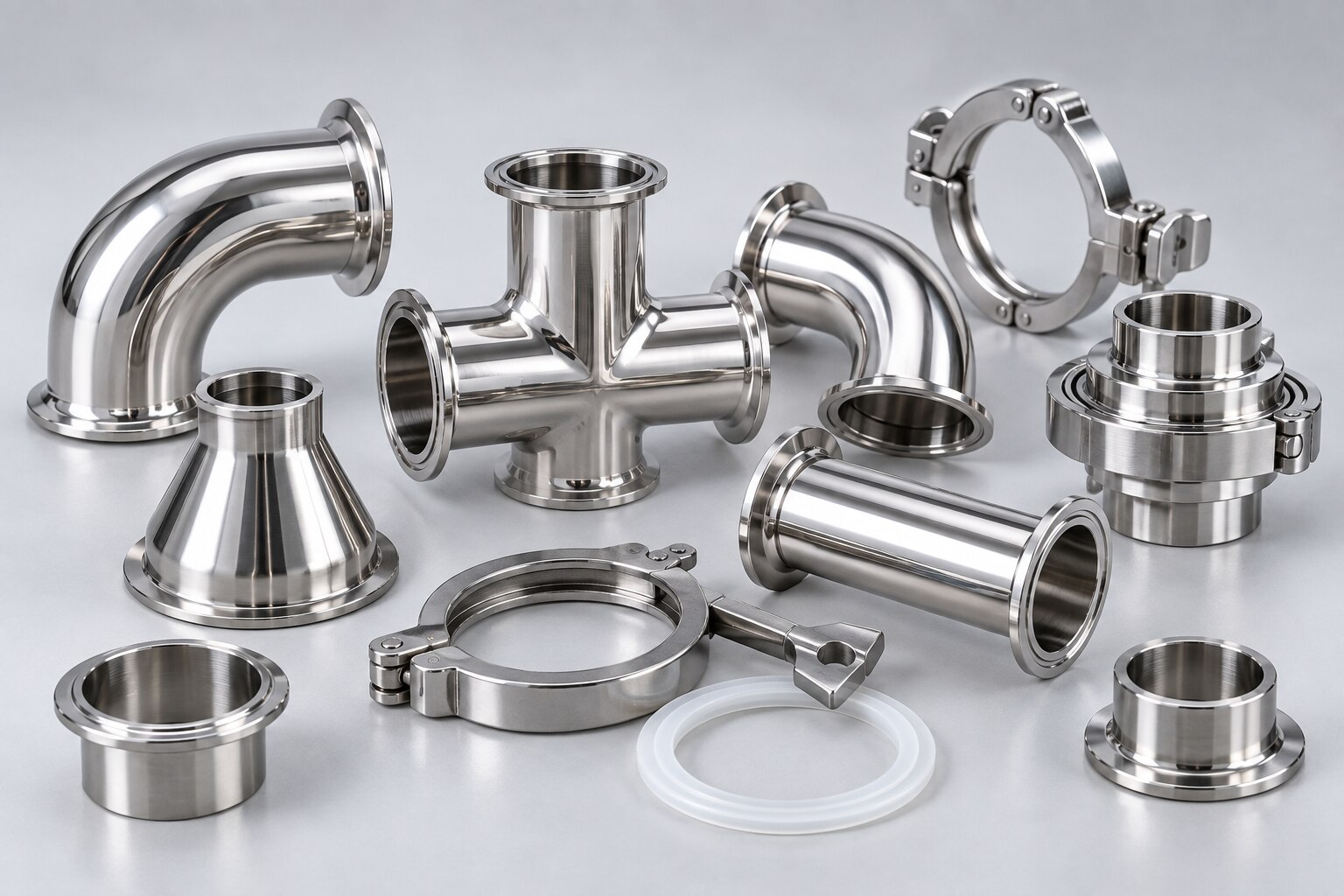
A forged fitting is not finished when a heated billet takes the shape of an elbow, tee or coupling. The material heat, forging temperature, die sequence, machining, heat treatment and inspection all determine whether the finished connection matches the drawing and service conditions. By the end, you will be able to follow each production stage, distinguish forging routes and specify the documents and checks required for a Chennai project.
Key takeaways
- Start with a traceable steel heat and verify its material test certificate.
- Match the fitting to pressure, temperature, material and connection requirements.
- Inspect the bore, socket, threads, dimensions and pressure-test documentation.
- Put the standard, schedule, grade, size, ends and certificates on the purchase order.
From certified billet to forged fitting: the production sequence
A traceable forged fitting begins with a verified heat of steel, not with machining. The forged fitting manufacturing process must preserve the link between raw stock and finished component.
1. Match the mill certificate to the billet or bar’s heat number before cutting. For ASTM A105/A105M carbon steel, ASTM A182/A182M stainless or alloy steel, and ASTM A350/A350M low-temperature steel, check the exact grade, chemical analysis, tensile and yield results, elongation, hardness, heat-treatment condition, and required impact results.
For A350/A350M LF2, confirm the impact-test temperature and absorbed energy.
2. Cut the identified billet or bar to a controlled charge weight, then reheat it within the grade’s specified forging range. Temperature records and heat-number segregation prevent mixed stock from entering the press.
3. Upset or preform the heated stock before die forging. Elbows, tees and crosses require controlled metal flow around curved bodies and branches; couplings and adapters can use simpler forgings followed by more machining.
4. Close the dies to form the recognisable fitting, then remove flash where excess metal escapes at the die parting line. Pierce or drill the passage after forging.
5. Apply the specified heat treatment, such as normalizing, tempering, quench-and-temper, or solution treatment for stainless steel. Descale or shot blast the surface before machining faces, bores, sockets and threads.
6. Perform final dimensional, visual, hardness, mechanical and specified nondestructive examinations. Machining cannot correct an incorrect or mixed grade, and a forged-looking shape is not proof of forging; require traceable forged stock, heat linkage and the documented forged fitting production steps.
How dies, heat and metal flow create the fitting shape
The die controls metal flow, forcing heated billet into the required cavity rather than cutting the shape from untouched stock. If you ask how are forged fittings made in Chennai, the answer depends on geometry, size and production quantity.
| Option | What it means | When it applies |
|---|---|---|
| Closed-die forging | Two dies compress billet in a shaped cavity; excess metal escapes as flash | Repeatable elbows, tees, crosses, sockets and many threaded fittings |
| Open-die forging | Dies shape a section without enclosing it completely | Simpler preforms, large sections and preliminary upsetting |
| Machining from bar or tube | Cutting tools remove stock to create the final form | Couplings, unions and adapters needing accurate CNC faces, bores or threads |
The forged fitting manufacturing process heats each billet inside the alloy’s specified forging window. A calibrated pyrometer checks temperature, while a controlled furnace atmosphere limits oxidation and decarburisation; reheating stays limited. Excessive heat creates scale, decarburisation and grain growth.
Insufficient heat causes laps, underfill and die cracking, and machining can leave those defects hidden beneath the finished surface.
Flash forms when excess hot metal escapes between closed die halves, showing that stock has filled the cavity and the dies have closed correctly. Trimming removes this outer ring without cutting into the pressure boundary.
Accurate preform design, clean and maintained dies, and controlled lubricant application prevent incomplete filling; poor lubrication or worn cavities distort flow. This is how forging consolidates stock around the fitting geometry rather than merely producing a forged-looking machined shape.
How the bore, socket and threads are finished and inspected
After the press, the forged fitting production steps establish the passage and connection features. Piercing or drilling opens the material; reaming brings the bore to size and sets socket depth. CNC turning machines faces, outside diameters and face-to-face dimensions, while thread cutting produces the specified threaded end.
Socket-weld fittings for engineering projects need accurate socket depth, bore diameter and end squareness. Excessive depth, an undersize bore or a tilted face causes poor weld fit-up and disrupts internal flow. Threaded fittings need the specified thread form and engagement, verified with calibrated go/no-go gauges.
Heat treatment follows forging when the material specification requires it. Carbon and alloy steel may require normalizing, tempering or quench-and-temper treatment; stainless grades require the specified solution treatment. Check that the chart records:
- Furnace number, cycle, holding temperature, holding time and cooling method
- Heat numbers linked to the fitting and material certificate
- Visual condition, dimensions, end preparation, hardness and material identification
- Tensile, yield, elongation and other specified mechanical-test results
- Magnetic-particle testing for surface defects in ferromagnetic steel
- Liquid penetrant testing for defects on non-porous stainless surfaces
- Ultrasonic testing when internal examination is specified
The final report must state the NDE method and acceptance criteria. “NDT tested” is incomplete: it does not tell you what was examined, how it was examined or which defects were acceptable.
Where forged fittings fit: comparison and engineering selection
Choose forged fittings for engineering when a compact socket-weld or threaded connection, consolidated stock and directional metal flow justify their extra weight and cost per small component.
| Option | Construction | Best fit | Main caution |
|---|---|---|---|
| Forged | Consolidated stock with directional metal flow | Compact, high-integrity socket-weld or threaded connections | Heavier and often costlier per component |
| Cast | Solidification structure | Complex shapes and unusual geometries | Inspect closely for shrinkage, porosity and other casting defects |
| Butt-weld | Made from pipe or formed plate | Larger NPS sizes and smooth welded transitions | Requires welding, alignment and weld inspection |
Do not select by nominal pressure alone. Availability, installed weight and the joining method can matter as much as the pressure class; a cast shape may be easier to obtain, while a butt-weld fitting may reduce turbulence and suit a large process line.
Check these forged fittings for engineering selection points:
- NPS
- Pressure class
- Socket-weld or threaded connection
- Schedule or wall thickness
- Material grade
- Design temperature
- Fluid compatibility
- Corrosion conditions
- Sour-service requirements
ASME B16.11 Class 2000, 3000, 6000 or 9000 is not a universal bar rating. Confirm the material group, temperature and project piping code before treating the class as a pressure limit. For H2S service, specify NACE MR0175/ISO 15156 and verify its material, hardness and environmental limits.
What to put on the purchase order for a Chennai project
Put the component identity on the purchase order, not just “forged fitting.” Ask the forged fitting supplier in Chennai to confirm the following against the drawing and project design basis:
1. State ASME B16.11 for forged socket-welding or threaded fittings, MSS SP-79 for socket-welding reducers, MSS SP-83 for unions, and ASME B16.25 when weld ends are specified. Apply IS 1239 or an ASME piping system only when it matches the approved design basis.
2. State ASTM A105/A105M for carbon-steel forgings, ASTM A182/A182M for stainless or alloy-steel forgings, or ASTM A350/A350M LF2 for low-temperature service. Include the exact grade, NPS, class, schedule or wall thickness, connection type and design temperature; a Class 3000 label alone is not a universal pressure rating.
3. Require permanent markings for size, class, material grade and heat number. Those markings must match the mill test certificate, heat-treatment chart, chemical and mechanical results, dimensional report and named NDE report.
4. Specify hydrostatic or pneumatic testing separately: medium, pressure, duration, cleaning or drying, witness arrangements and certificate format. ASME B16.11 does not prove that each fitting received an individual pressure test.
5. Ask, “How are forged fittings made in Chennai?” Require confirmation that the marked heat was verified before billet cutting, not merely machined from unidentified stock. Mercury Metalinks is useful when it supplies traceable stock and complete records, but verify every certificate and marking against your specification.
Related product
 | FORGED FITTINGS Mercury Metalinks Mercury Metalinks is a trusted supplier and stockist of premium-quality Forged Fittings, offering a comprehensive range of... View product → |
Frequently asked questions
What are the main forged fitting production steps?
The sequence runs from certified billet selection and cutting through heating, die forging, heat treatment, machining, inspection and documentation.
How do dies, heat and metal flow shape a forged fitting?
Heated billet is compressed inside shaped dies, which direct metal flow into the fitting form while reducing internal discontinuities.
How are the bore, socket and threads finished?
Machining establishes the bore and socket dimensions, while threading tools produce the specified thread form; inspectors then check size, surface condition and alignment.
What should you specify when buying forged fittings for a Chennai project?
State the standard, pressure class or schedule, nominal size, material grade, connection type, end preparation, testing requirements and certificates.