Dairy fittings earn their higher price only when a pipe carries product, cleaning chemicals, or another service where hygiene, drainability and corrosion resistance affect validation and uptime. By the end, you will be able to classify each line, select the right connection and material, verify a quotation, and reject sanitary components where ordinary fittings are the better value.
Key takeaways
- Use hygienic fittings on product-contact lines, not ordinary utility services.
- Confirm the connection standard before ordering pipes, ferrules, clamps and gaskets.
- Specify stainless steel grade, internal finish, drainability and weld quality together.
- Compare cleaning, downtime and replacement costs—not only the fitting’s purchase price.
When dairy fittings justify their higher price
Hygienic dairy fittings justify their higher price on product-contact lines carrying milk, yoghurt, beverages, ingredients or medicines, where cleanability, drainability and contamination control affect production. They are unnecessary on non-product-contact utilities such as cooling water, compressed air, fire water or general drainage, where ordinary fittings meet the pressure and corrosion requirements.
| Piping line | Fitting choice | Decision reason |
|---|---|---|
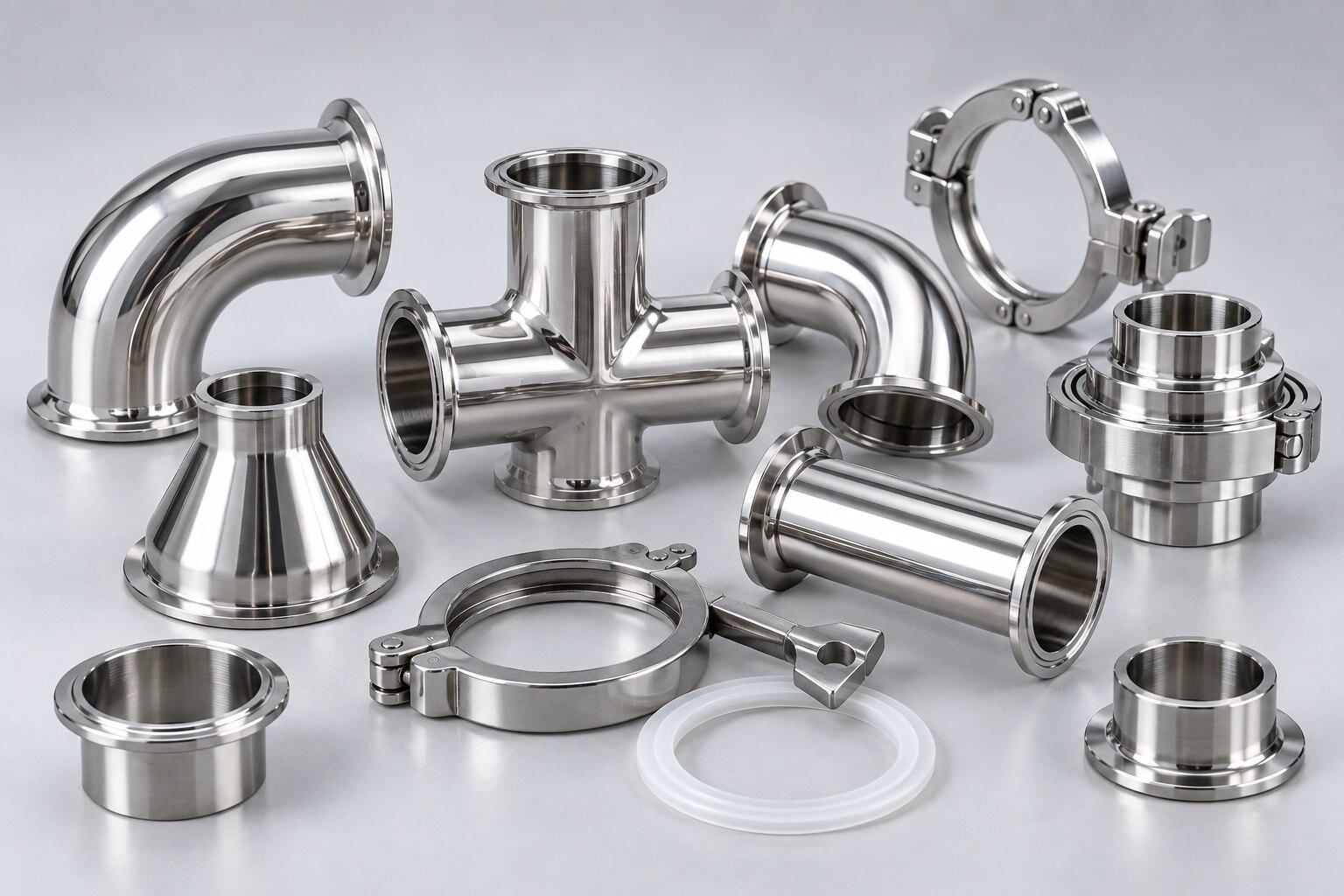
| Product-contact milk or beverage line | Hygienic dairy fittings | Ferrules, clamps, elbows, tees, reducers and valves must drain fully and avoid crevices that retain product during CIP |
| Pharmaceutical or high-purity process line | Hygienic fittings to the project standard | Confirm whether the specification calls for 3-A, EHEDG, ISO, ASME BPE or a customer standard; “sanitary” alone is incomplete |
| CIP return or product-recovery line | Hygienic fittings | Dead legs, poor slopes and valve cavities can leave residue after cleaning |
| Cooling water, compressed air or fire-water line | Ordinary industrial fittings | Product contamination is not the design risk; pressure rating, corrosion resistance and maintainability matter more |
| Structural, drain or non-contact service line | Ordinary fittings | Paying for polished internal surfaces and sanitary seals adds cost without improving the process |
For dairy fittings for piping contractors in Mumbai, compare more than stainless-steel grade. Check the internal finish, tube wall, gasket material, pressure and temperature rating, heat-number traceability and inspection documents. Industrial dairy fittings with the wrong elastomer or an undocumented finish can fail acceptance even when the fitting looks clean.
Check branch geometry, slope and valve orientation on the isometric drawing before ordering.
Choose the connection standard before you order
A connection standard must match the existing equipment, tube dimensions and cleaning method; “sanitary” is not a fit-up specification. Obtain the plant drawing or customer standard before ordering dairy piping fittings in Mumbai, then verify outside diameter, wall thickness, ferrule profile, gasket seat and valve-end dimensions. Nominal bore alone will not prevent a mismatch.
| Option | What it means | When it applies |
|---|---|---|
| Tri-Clamp | Ferrules joined by a gasket and clamp; quick to dismantle | Frequent cleaning, skid connections and lines requiring fast changeover |
| DIN 11851 | Threaded dairy union with a sealing ring | Existing European dairy equipment already using this union pattern |
| ISO 2852 | Standardised clamp coupling with defined ferrule and gasket geometry | Projects specifying ISO 2852 rather than a generic clamp connection |
| SMS | Swedish dairy union with its own thread and sealing arrangement | Equipment, valves and replacement parts designed to SMS dimensions |
| DIN 11864 or ASME BPE | More controlled hygienic interfaces for specialised process systems | Pharmaceutical, bioprocess or customer-specified installations |
Do not combine a DIN 11851 nut with an SMS insert, or a Tri-Clamp ferrule with an ISO 2852 gasket, because the joint can leak, trap product or fail during commissioning.
Ask the supplier to state the connection standard, tube OD, wall thickness, gasket material, pressure-temperature rating and applicable 3-A, EHEDG, ISO or customer requirement on the quotation. Confirm the mating part before releasing the purchase order.
Material, finish and installation decide whether the line stays sanitary
Use 316L stainless steel for product-contact industrial dairy fittings when cleaning chemicals, chloride exposure or high-temperature service could attack 304 stainless steel. Demand mill test certificates and heat numbers so the material can be traced; do not accept “stainless steel” as a complete specification.
Specify the hygienic surface finish on the purchase order, not only in the drawing. A common requirement is an internal finish of Ra ≤0.8 µm, with smoother electropolished surfaces reserved for higher-purity service where the project standard calls for them. Rough welds, pits and scratches trap milk solids, harbour bacteria and accelerate corrosion.
- Select EPDM, PTFE, silicone or FKM seals against the actual product, CIP chemicals, temperature and sterilisation cycle; an incompatible gasket can swell, shed particles or leak.
- Require crevice-free butt welds or approved hygienic clamps, with welds internally aligned, purged and finished smooth.
- Check every branch, instrument tee, valve cavity and reducer on the isometric for drainability; a catalogue fitting cannot reveal a badly arranged installation.
- Keep branch dead legs within the project limit, such as the L/D ≤2 rule where ASME BPE or the customer specification applies.
- Install the line at the specified continuous slope toward drain points, orient eccentric reducers correctly and place valves so cavities do not retain product.
- Confirm the exact finish, gasket and configuration behind any 3-A, EHEDG or ISO conformity claim; replacing a listed seal can remove that compliance basis.
Test the completed line for visual cleanliness, weld quality, drainage and CIP coverage before handover. Document heat numbers, finish records, gasket material and as-built orientation.
Compare the lifecycle cost, not the fitting’s unit price
A lower unit price wins only if it does not create extra labour, longer cleaning cycles or an early shutdown. Compare each quotation over the line’s expected operating life, not by nominal diameter alone.
| Cost area | Ordinary or threaded fitting | Hygienic fitting |
|---|---|---|
| Purchase | Lower price, but confirm grade, dimensions and compatibility | Higher price, with ferrule, gasket, finish and standard specified |
| Installation | Thread sealant, alignment and rework can add labour | Clamp assembly is quick; hygienic welding costs more but removes gasket joints |
| Cleaning | Crevices can retain product and increase flushing time | Smooth, drainable surfaces reduce soil retention when installed correctly |
| Replacement | Unplanned leakage can require cutting or dismantling | Budget clamps, ferrules, gaskets and valve seals as consumables |
| Documentation | Basic invoice or material statement | Heat number, material certificate, finish record, gasket certificate and test reports |
For piping contractor fittings in Mumbai, request a like-for-like quotation that includes these fields:
- Material grade, tube standard and wall thickness
- Tri-Clamp, DIN 11851, ISO 2852, SMS or specified connection standard
- Internal surface finish, pressure and temperature rating
- Gasket material, operating limits and replacement availability
- Inspection, pressure-test and traceability documents
Price cleaning by access time, chemical use and production downtime. Price installation by welding, orbital-weld inspection, alignment and passivation rather than fitting count. A clamp joint can reduce assembly time, but incorrect ferrule alignment or gasket compression causes leaks and repeated sanitation work.
Do not pay for ASME BPE paperwork unless the project calls for it; dairy work may specify 3-A, EHEDG, ISO or a customer standard. The cheapest documented fitting is the cheaper fitting only after these costs match.
Use local stock without sacrificing traceability
A same-day ferrule or replacement seal is useful only if you can prove it belongs in the specified process line. Get the project’s named hygienic standard and approved material schedule before buying from local stock; “dairy grade” and “sanitary” alone do not define acceptance.
Ask the stockist to identify every shutdown-critical item by size, connection and drawing reference, not by nominal diameter alone. A locally available fitting with no heat number, finish record or elastomer specification can delay validation after installation.
Request these details on the quotation:
- Stainless-steel grade, tube standard and wall thickness
- Connection standard and exact dimensional series
- Internal surface finish, with the measured or specified Ra value
- Gasket or seal material, temperature range and CIP chemical compatibility
- Pressure and temperature rating
- Heat number, certificate of conformity and inspection or test records
- Replacement-seal availability, batch or lot identification and shelf-life information
Check the seal against the valve or ferrule manufacturer’s dimensions. EPDM, silicone, PTFE and FKM are not interchangeable: a seal that fits mechanically can swell, crack or contaminate product during hot cleaning.
Before release, compare the supplier’s drawing with your isometric for branch geometry, slope, valve orientation and drainability. Mercury Metalinks can support a document-by-document comparison for local dairy piping fittings in Mumbai, but you remain responsible for matching the project specification.
Do not search for a furniture fittings supplier in Mumbai when you need process hardware. Furniture fittings are hinges and slides; dairy components are hygienic piping parts with traceable materials and seals.
Related product
 | FURNITURE & DAIRY FITTINGS Mercury Metalinks Mercury Metalinks is a trusted supplier and stockist of premium-quality Furniture & Dairy Fittings, offering a wide range of... View product → |
Frequently asked questions
When are dairy fittings worth their higher price?
Choose hygienic dairy fittings for product-contact lines carrying milk, yoghurt, beverages, ingredients or medicines. Use ordinary fittings for cooling water, compressed air, fire water and general drainage when their pressure and corrosion performance is sufficient.
Why must you choose the connection standard before ordering dairy piping fittings?
The standard determines whether pipes, ferrules, clamps, gaskets and valves will mate correctly. Confirm the complete connection system before placing an order to avoid mismatched components and rework.
Which material, finish and installation details affect sanitary performance?
Specify the stainless steel grade, internal surface finish, weld quality, smooth transitions, drainability and gasket compatibility. Poor alignment, crevices, dead legs or rough welds can undermine cleanability even when the fittings are hygienic.
How should piping contractors compare the lifecycle cost of dairy fittings?
Include purchase price, installation labour, cleaning time, product loss, contamination risk, inspection, downtime and replacement parts. A higher-priced fitting can cost less overall when it reduces cleaning problems and unplanned shutdowns.
How can you use local stock without losing traceability?
Request material certificates, heat or batch numbers, dimensional records and gasket identification with the supplied fittings. Match those records to the installation package before releasing components for fabrication.