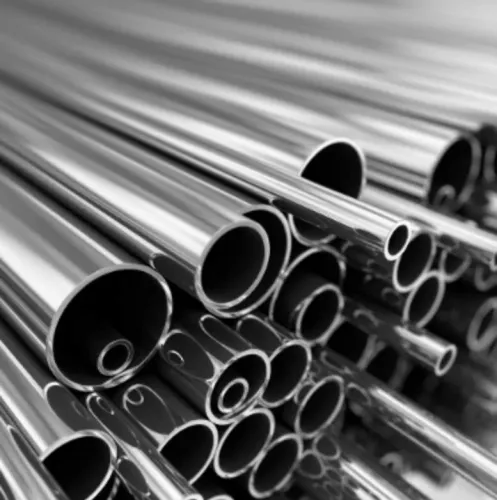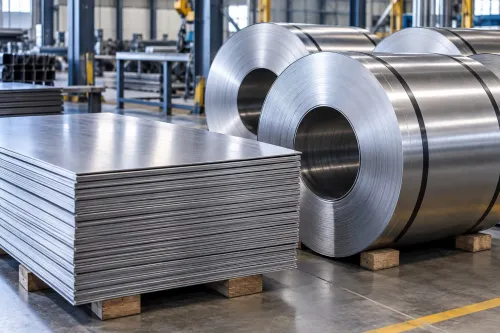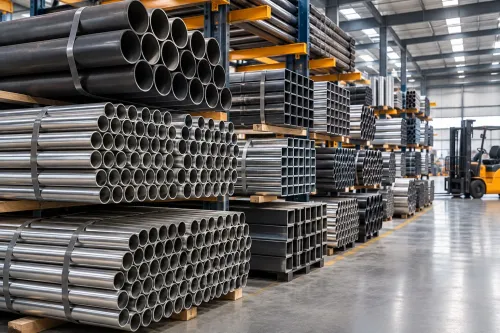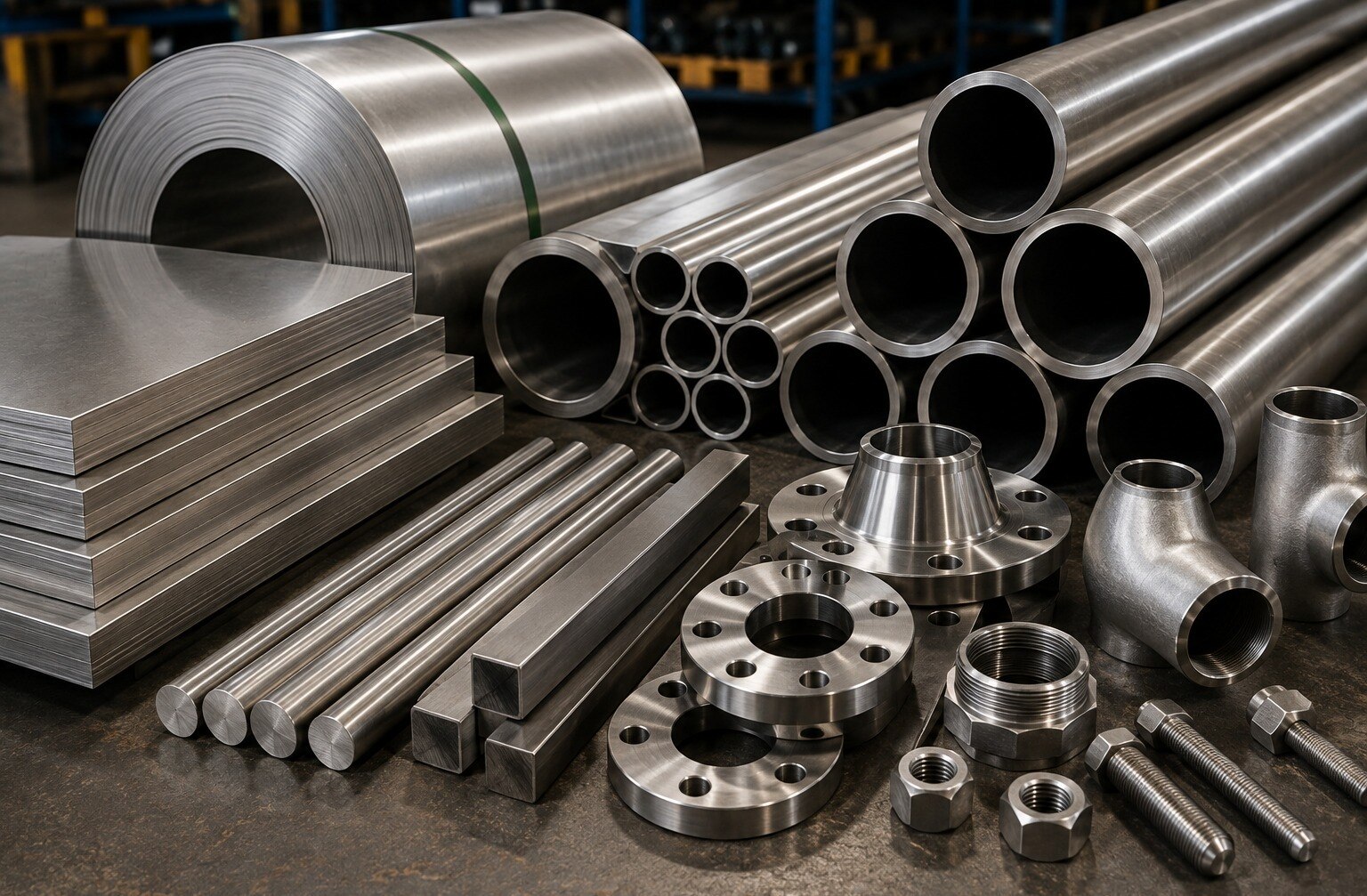
A quotation for “super duplex” is incomplete until it names the UNS grade, product form, governing standard, dimensions, testing and certification. By the end, you will be able to compare S32750 and S32760, specify the material for pipe, plate, fittings or bar, and check whether a Hyderabad quotation includes the evidence your application requires.
Key takeaways
- Specify UNS S32750 or UNS S32760 before requesting quotations.
- Match every product form with its ASTM, ASME or EN standard.
- Require heat-treatment records, phase-balance evidence and mechanical test results.
- Write dimensions, tolerances, testing and documentation into the purchase order.
Choose the grade before comparing quotations
Specify the UNS grade before asking for prices. For super duplex steel for specifications in Hyderabad, “super duplex SS” is incomplete: put UNS S32750 or UNS S32760, the exact ASTM, ASME or EN product standard, and the required heat-treatment condition on the enquiry.
EN 1.4410 and EN 1.4501 help identify 2507-type and tungsten-bearing material, but they do not define every delivery requirement.
| Grade/designation | Chemistry limits to state or verify, mass % | Procurement distinction |
|---|---|---|
| UNS S32750 / EN 1.4410 | Cr 24–26, Ni 6–8, Mo 3–5, N 0.24–0.32, C ≤0.030; Mn ≤1.20, Si ≤0.80, P ≤0.035, S ≤0.020, Cu ≤0.50 | Common 2507 grade; confirm the product standard |
| UNS S32760 / EN 1.4501 | Cr 24–26, Ni 6–8, Mo 3–4, N 0.20–0.30, Cu 0.50–1.00, W 0.50–1.00; C ≤0.030 | Tungsten- and copper-bearing; not automatically interchangeable with S32750 |
Write the super duplex steel product details as a purchasing checklist:
- State ASTM A240 or ASME SA240 for plate and sheet; ASTM A790 or A928 for pipe; ASTM A182 for forged flanges; ASTM A815 for wrought fittings; ASTM A276 or A479 for bar.
- Request the mill heat number, EN 10204 3.1 or 3.2 certificate, solution-annealing and rapid-quench record, and ASTM A923 testing when specified.
- Do not accept “in stock” as proof of suitability for pressure, sour-service or corrosive duty. Compare chemistry, dimensions, mechanical values and traceability first.
Match each product form to its standard and mechanical requirements
A 1.4410 or 1.4501 designation does not define the delivered item. Your purchase order must identify the UNS grade, exact product standard, size, tolerance, solution-annealing condition and tests. These super duplex steel product details prevent an industrial super duplex steel quotation from hiding a form or standard mismatch.
| Form | ASTM or ASME standard | Dimensions and mechanical requirements |
|---|---|---|
| Plate or sheet | ASTM A240 or ASME SA240 | Specify thickness, width, length and ASTM A480 or SA480 tolerances. Require tensile strength, yield strength, elongation, hardness and impact testing where the order or grade requires it. |
| Seamless or welded pipe | ASTM A790 or ASME SA790 | State outside diameter, wall thickness, length and ASTM A999 tolerances. Require tensile, yield, elongation, hardness and hydrostatic or electric testing; add flattening tests for welded pipe when specified. |
| Welded pipe with filler metal | ASTM A928 | State diameter, wall, weld type, filler metal and heat treatment. Require tensile and weld-related tests specified by A928, plus hydrostatic or electric testing. |
| Forged flanges or fittings | ASTM A182 or ASME SA182 | Use ASME B16.5 or B16.47 dimensions and pressure class. Require tensile, yield, elongation, hardness and impact tests where specified. |
| Wrought fittings | ASTM A815 | State fitting geometry, wall thickness, ends and dimensions. Require tensile, yield, elongation and hardness results under the standard. |
For pipe, do not accept “super duplex” alone: A790 and A928 impose different welding controls. Agree the ASTM A923 method and acceptance criteria in advance; metallographic, Charpy and ferric-chloride methods are not interchangeable. Tie every result to the heat number and an EN 10204 type 3.1 or 3.2 certificate.
Control heat treatment, phase balance and fabrication risks
Accept an industrial super duplex steel lot only after confirming its heat-treatment condition and phase balance. Tensile strength and elongation alone cannot reveal excessive ferrite, excessive austenite, or harmful intermetallic phases that reduce toughness and localized-corrosion resistance.
Request these acceptance records:
- Solution-annealing temperature, holding time, rapid-cooling method, furnace identity and heat or lot traceability. Slow cooling through about 600–1,000 °C can form sigma or chi phases even when the chemistry is correct.
- Ferrite–austenite balance evidence from an agreed examination or test. A certificate that reports only chemistry and tensile results is incomplete.
- EN 10204 type 3.1 certification tied to the heat number, with chemical analysis, mechanical results, dimensions, heat treatment and visual inspection. Use type 3.2 when the purchaser or an independent inspector must witness validation.
For pipe, identify ASTM A790 for seamless or welded pipe, or ASTM A928 when the welded pipe uses filler metal. State whether the weld is autogenous or filler-assisted, then verify the welding procedure, filler compatibility, post-weld solution annealing and heat-affected-zone examination. Poor control can leave a corrosion-sensitive weld despite compliant parent metal.
Agree the ASTM A923 method and acceptance criterion before testing:
- Metallographic etch examination
- Charpy impact testing
- Ferric-chloride corrosion testing
Do not treat A923 as one universal pass/fail test. Also specify pickling and passivation after fabrication where service demands it; iron contamination, gasket crevices, deposits and dead legs can initiate attack. Preserve the heat number on every cut remnant.
Write dimensions and inclusions into the purchase specification
Put the delivered form and acceptance details on the purchase order, not in a quotation note. State the UNS grade, exact product standard, size, schedule or thickness, quantity, length, surface condition, end preparation, facing and dimensional tolerance. “Super duplex pipe” is not a measurable specification.
1. For pipe, specify outside diameter, wall thickness or schedule, nominal length, random or cut length, end type, bevel angle, root face and end squareness. For flanges, add ASME class, raised-face, flat-face or ring-type joint facing, bolt-hole circle, bore, thickness and drilling standard.
2. State the dimensional tolerance against the selected ASTM, ASME or EN product standard, including diameter, wall, length, flange thickness and facing finish. Record whether cutting loss, extra length or machining allowance is included in the quantity.
3. Name the inspection scope: visual and surface inspection, dimensional checks, hardness, tensile and impact tests, hydrostatic or NDE requirements, and PMI limitations. If ASTM A923 applies, identify its metallographic, Charpy or ferric-chloride method and acceptance criteria; do not request a vague “A923 test.”
4. Require an EN 10204 type 3.1 certificate linked to every heat number, showing chemical analysis, mechanical results, heat treatment, product-standard compliance, dimensions and inspection findings. Specify type 3.2 when your inspector or an independent body must witness or validate testing.
5. Require heat-number marking on each piece and every cut remnant, plus furnace or lot traceability, packing that prevents chloride and iron contamination, and inspection hold points before dispatch.
This super duplex steel procurement checklist prevents acceptable stock from being supplied in the wrong end condition, tolerance or traceability status.
Screen a Hyderabad supplier before stock is released
A rack marked “super duplex” proves availability, not suitability. Before releasing stock, match the heat, grade, product form, standard, dimensions and condition to your purchase order; S32750 under ASTM A240 is not interchangeable with S32760 under ASTM A790.
Use this super duplex steel procurement checklist before dispatch:
- Require the UNS number, product form, ASTM, ASME or EN standard, size, tolerance and surface condition.
- Check the heat number on the material against the EN 10204 Type 3.1 certificate. Request Type 3.2 when your inspector or an independent body must witness or validate results.
- Confirm solution annealing followed by rapid quenching, plus furnace or lot traceability. Slow cooling through roughly 600–1,000°C can leave sigma or chi phases that reduce toughness and corrosion resistance.
- Ask for chemical analysis, mechanical results, dimensional and visual inspection, and ASTM A923 results or another agreed supplementary test.
- Define PMI limits: handheld PMI verifies alloying elements but does not prove heat treatment, phase balance or full compliance.
- Record cutting-loss allowance and require the heat number on every cut remnant.
Availability versus compliance is easier to test against the same evidence:
| Check | Stock evidence | Compliance evidence |
|---|---|---|
| Grade and form | Supplier listing | UNS number and product standard |
| Traceability | Heat number on bundle | Matching 3.1 or 3.2 certificate |
| Condition | “Annealed” notation | Annealing, quench and lot records |
| Dispatch | Wrapped pieces | Chloride- and iron-contamination control, inspection hold point |
Mercury Metalinks becomes worth comparing only if it can provide these records before dispatch, rather than treating a warehouse label as acceptance evidence.
Related product
 | SUPER DUPLEX STEEL Products – Mercury Metalinks Mercury Metalinks is a trusted supplier and stockist of premium-quality Super Duplex Steel Products, offering a... View product → |
Frequently asked questions
Which super duplex steel grade should Hyderabad buyers specify?
Choose the UNS grade first: UNS S32750 and UNS S32760 have different chemistry and product-standard requirements.
How do product forms affect super duplex steel specifications?
Match plate, pipe, tube, bar, forgings and fittings to the applicable ASTM, ASME or EN standard and mechanical requirements.
What fabrication risks must buyers control?
Control solution annealing, rapid cooling, phase balance, heat input, interpass temperature and contamination during fabrication.
What should a super duplex steel purchase specification include?
State the grade, product form, standard, dimensions, tolerances, heat-treatment condition, tests, certificates, marking and packaging.
How can you screen a super duplex steel supplier in Hyderabad?
Check traceability, heat numbers, test certificates, stock condition, inspection records, documentation and the supplier’s ability to release conforming material.