Use the part’s true volume, the confirmed titanium grade, and a consistent unit system to calculate mass in kilograms. By the end, you will be able to estimate sheets, bars, pipes, tubes, fittings, and cut blanks, then separate theoretical material weight from the quantity you actually buy and receive.
Key takeaways
- Use mass = volume × density with one consistent unit system.
- Calculate sheets, bars, pipes and fittings from their actual geometry.
- Separate theoretical mass from packing, cutting allowance and dispatch weight.
- Compare quotations using grade, dimensions, density and documented weight basis.
Start with volume, density, and one unit system
Mass equals volume multiplied by density. Use this titanium weight formula before choosing a sheet, bar, pipe, or fitting equation, and keep one unit system throughout.
For metric dimensions, mass (kg) = volume (m³) × density (kg/m³). If every dimension is in millimetres, use mass (kg) = volume (mm³) × density (g/cm³) ÷ 1,000,000,000. This is the basic answer to how to calculate titanium weight without mixing millimetres, metres, grams, and kilograms.
| Grade | Planning density | Use |
|---|---|---|
| Commercially pure titanium | 4.506 g/cm³ or 4,506 kg/m³ | General CP titanium estimate |
| Grade 2 | About 4.51 g/cm³ | Grade 2 sheet, plate, bar, or tube |
| Grade 5 Ti-6Al-4V | About 4.43 g/cm³ | Grade 5 alloy estimate |
Use the density on the mill’s material certificate instead of a generic 4.50 g/cm³ value. Grade and product form must match the certificate.
A 1,000 mm × 1,000 mm × 1 mm Grade 2 sheet contains 1,000,000 mm³, so its theoretical mass is approximately 4.506 kg before tolerances and processing. Trade quotations use mass in kilograms; force equals mass × 9.80665 and is measured in newtons.
Calculate the finished blank from its ordered cut dimensions, not the larger parent-stock dimensions. Parent stock includes the material purchased before cutting, so its weight also includes trim, kerf, and unused remnants.
Apply the right equation to sheets, bars, pipes, tubes, and fittings
For a titanium weight calculation in Hyderabad, use the dimensions of the ordered cut piece, not the parent stock.
| Form | Dimensions to use | Calculation |
|---|---|---|
| Sheet or plate | Length, width, thickness | L × W × t × density ÷ 1,000,000,000 |
| Solid round bar | Diameter and length | π × d² ÷ 4 × L × density ÷ 1,000,000,000 |
| Square, rectangular, or flat bar | Width, thickness, length | W × t × L × density ÷ 1,000,000,000 |
| Hexagonal bar | Across-flats dimension and length | Hexagonal section area × L × density; use the applicable formula or supplier section table |
| Pipe or tube | OD, wall thickness, length | π/4 × (OD² − ID²) × L × density ÷ 1,000,000,000 |
Use diameter, not radius, for a round bar. Putting the bar into the sheet formula, or squaring the radius incorrectly, creates a major error. For a hex bar, the regular-section area from across flats is approximately 0.866025 × AF².
For an angle, calculate the two rectangular legs, subtract their overlapping corner area, and multiply by length. Include the corner radius as an estimate unless the drawing gives the exact section area.
For hollow products, ID = OD − 2t. Do not treat nominal bore as OD or use a schedule without checking the governing dimensional table and actual wall. A solid-bar formula overstates tube mass.
For fittings and irregular cut shapes, use approved drawing or CAD volume × density, then subtract bore, socket, weld-end, flange, and machining removals. That is the practical answer to how to calculate titanium weight when no simple section formula applies.
Build a titanium weight calculator fabrication team can reproduce
1. Create input cells for product form, grade, certified density, length, width or outside diameter, thickness or wall, quantity, and units. Keep every dimension in millimetres, or convert every dimension to metres before calculating. Label three outputs separately: theoretical finished-part weight, cut-blank or nesting weight, and parent-stock purchase weight.
2. Use the form-specific equation in the calculator, then save the formula beside the result. For a 2,000 mm × 1,000 mm × 3 mm Grade 2 plate, enter 4.506 g/cm³: 2,000 × 1,000 × 3 × 4.506 ÷ 1,000,000 = 27.036 kg.
A 25 mm diameter × 1,000 mm Grade 5 round bar uses π × 25² ÷ 4 × 1,000 × 4.43 ÷ 1,000,000 = about 2.174 kg. The conversion denominator is 1,000,000 for mm³, not 1,000,000,000.
3. For a tube, calculate ID as OD − 2 wall: 60 − 10 = 50 mm. Then use π/4 × (60² − 50²) × 3,000 × 4.506 ÷ 1,000,000 = 11.68 kg. A claimed 23.25 kg represents roughly 6,000 mm, not 3,000 mm.
Check this before approving any titanium weight calculator fabrication or titanium weight calculation in Hyderabad.
For repeat orders, multiply weight per piece by quantity only after checking kerf, edge trim, nesting loss, and remnants. Those allowances can require a larger parent plate than the finished-part total suggests.
Separate theoretical mass from dispatch and purchase weight
A spreadsheet result is theoretical weight: geometric mass calculated from nominal dimensions and certified density, not a guaranteed scale reading. Actual dispatch mass changes with mill tolerance, cut-length tolerance, plate or bar oversize, tube ovality, straightness, corner radius, surface condition, weld cap, machining allowance, end closures, and remnants.
Keep three quantities separate. The finished-part estimate uses approved drawing dimensions; blank weight adds saw kerf, plasma kerf, edge trim, turning allowance, and nesting loss; parent-stock purchase weight includes unusable remnants. Do not bury these allowances in one unexplained percentage. For a cut blank, use the approved drawing dimensions.
For a plate order, state whether payment covers the blank or the parent sheet.
| Billing basis | Meaning | What to confirm |
|---|---|---|
| Theoretical weight | Nominal geometry × certified density | Drawing dimensions and density |
| Dispatch scale weight | Material weighed at shipment | Calibrated scale or weighbridge record |
| Certified piece weight | Weight assigned to identified pieces | Piece identification and certificate |
Specify the billing basis on the purchase order. Reconcile receipt against the mill certificate, heat number, dimensional inspection, and calibrated scale or weighbridge record. ASTM B265 covers titanium strip, sheet, and plate; ASTM B348 covers bars and billets. Verify grade and form against the certificate; “titanium” alone proves neither.
Use the titanium weight formula consistently when comparing quotations: theoretical dimensions versus actual stock, not one supplier’s hidden allowance against another’s. This is how to calculate titanium weight without confusing finished-part mass with material purchased.
Use the calculation when comparing Hyderabad supplier quotations
A kilogram quote is comparable only when every Hyderabad supplier has priced the same material, dimensions, allowances, and delivery basis. Send the approved drawing or dimension schedule, stating:
- Grade, product form, quantity, cut size, thickness or wall, length, surface condition, and required standard.
- For pipe or tube: outside diameter, actual wall thickness, length, and seamless or welded construction. Nominal size and schedule alone are unsafe without the dimensional standard and actual wall.
- Separate material price, cutting charge, machining charge, testing, packing, freight, GST, minimum order, and delivery basis.
Request a mill test certificate showing grade, heat number, chemistry, mechanical results, dimensions, and applicable ASTM standard. A local stockist such as Mercury Metalinks can help source cut-to-size titanium and documentation for a Hyderabad fabrication order, but availability does not prove ASTM compliance or show what the kilogram rate includes.
Compare every offer on identical terms:
| Option | Quantity basis | Allowance policy | Billing method | Final reconciliation |
|---|---|---|---|---|
| Theoretical | Finished-part or approved cut quantity | Cutting and machining stated separately | Theoretical mass | Reconcile against dimensions and certificate |
| Weighed | Dispatched quantity | Kerf, trim, and remnants identified separately | Scale or weighbridge mass | Reconcile against calibrated scale record |
Use the same density and state whether your titanium weight calculator fabrication result and purchase order will use theoretical or weighed mass.
Related product
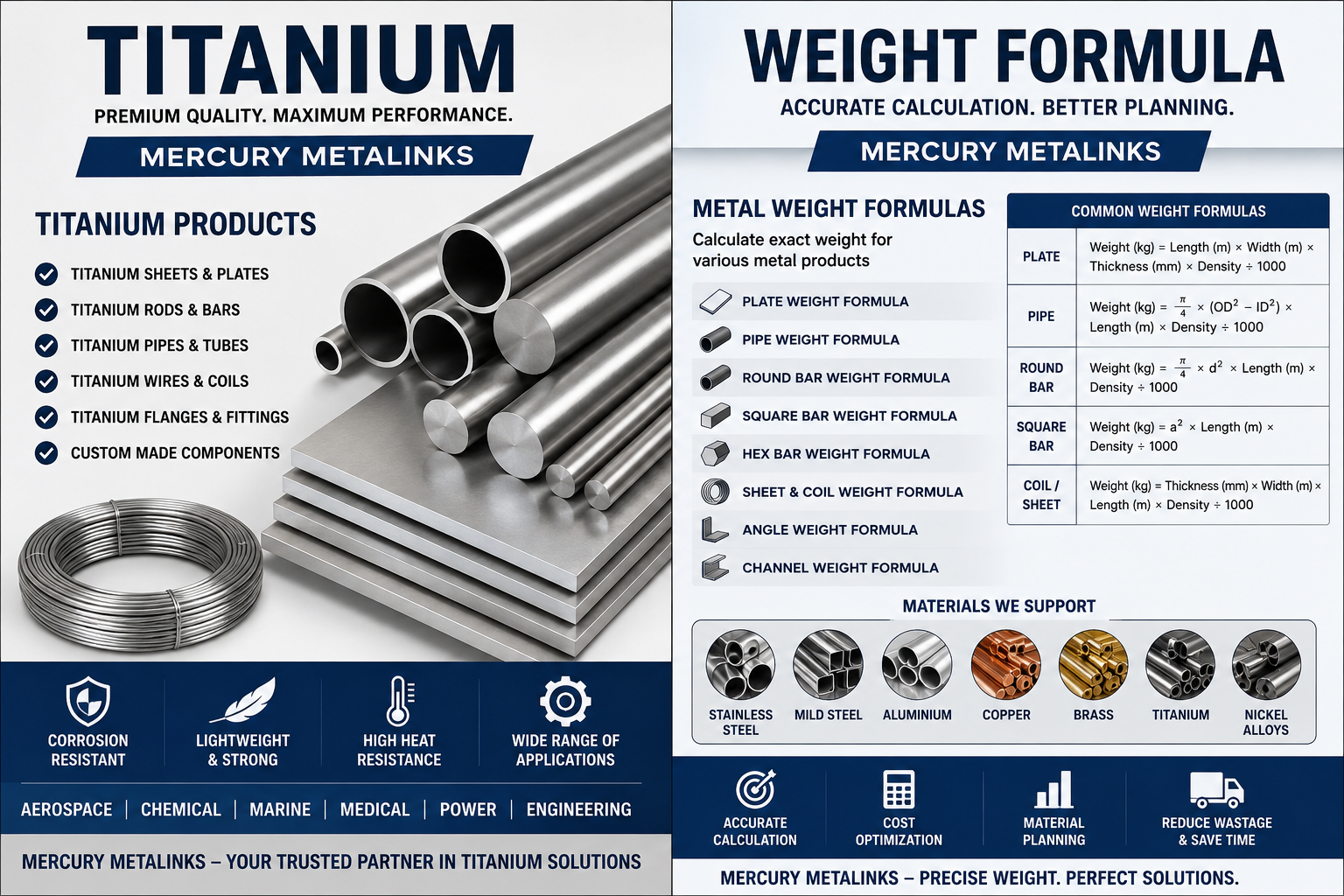 | TITANIUM & WEIGHT FORMULA Titanium Products Description – Mercury Metalinks Mercury Metalinks is a trusted supplier and stockist of premium-quality Titanium Products, catering... View product → |
Frequently asked questions
What is the basic titanium weight formula?
Calculate mass by multiplying volume by density. Keep dimensions and density in compatible units, such as millimetres with kilograms per cubic metre after conversion.
How do you calculate titanium weight for sheets, bars, pipes and tubes?
Calculate the shape’s volume first: length × width × thickness for sheets, cross-sectional area × length for bars, and annular area × length for pipes and tubes. Multiply the result by titanium density.
What should a fabrication team include in a titanium weight calculator?
Record grade, density used, dimensions, quantity, unit conversions, formula, theoretical mass, cutting allowance and the person who checked the result.
Why does theoretical titanium mass differ from dispatch weight?
Theoretical mass excludes packaging, protective materials, excess length, cutting loss and fabrication remnants. Dispatch weight includes the items and packing actually weighed.
How can titanium weight calculations help compare Hyderabad supplier quotations?
Use the same grade, dimensions, density, quantity and weight basis for every quotation, then ask suppliers to identify theoretical, net and gross dispatch weights.