A ferrule fitting quotation is incomplete if it gives only a nominal size or says “high pressure.” By the end, you will be able to define the tube, fitting geometry, material, thread, service conditions, documentation, installation method, and inspection checks needed for a Hyderabad tube project.
Key takeaways
- Specify tube OD, wall thickness, pressure rating, material, threads, and standards.
- Use the fitting’s tube-size range; never substitute nominal pipe size for tube OD.
- Front and back ferrules seal and grip through controlled tube deformation.
- Confirm material compatibility, certificates, and installation instructions before ordering.
What a Ferrule Fitting Includes and How It Seals the Tube
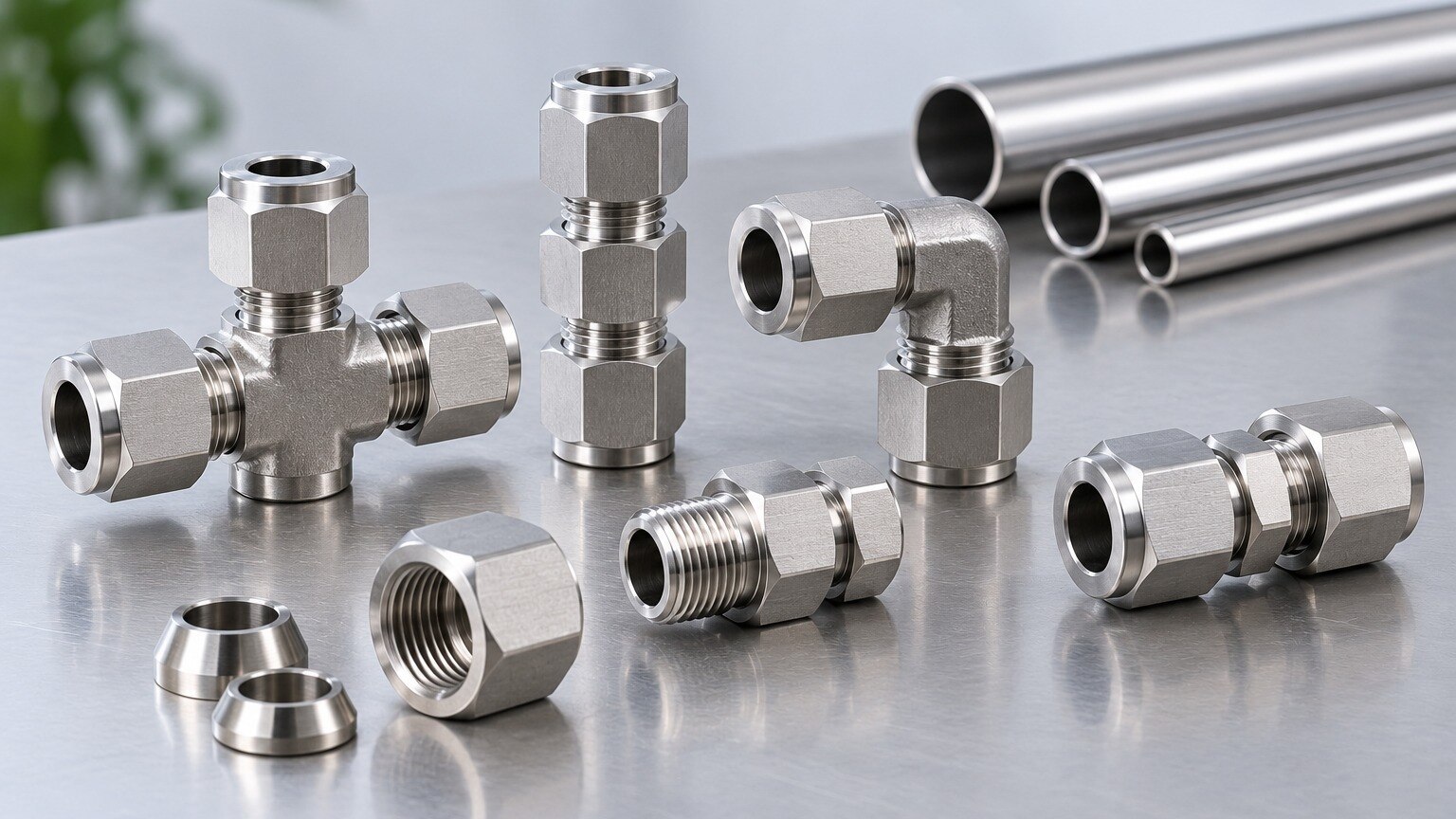
A ferrule fitting joins a tube by controlled deformation, not by thread sealant. In a double-ferrule assembly, tightening the nut drives the front ferrule against the fitting body and tube to create the primary seal; the back ferrule grips the tube and resists pull-out and vibration.
The body, nut, front ferrule, and back ferrule form a matched system. Do not mix parts from different brands unless the manufacturer has demonstrated interchangeability. Single-ferrule designs use one ferrule for sealing and retention.
A complete ferrule tube fittings specifications entry must state:
- Tube outside diameter in millimetres or inches, never nominal pipe size; 12 mm and 1/2 inch are different tube dimensions.
- Tube wall-thickness range, material, dimensional tolerance, and approved hardness range.
- Fitting material and product form, such as 316 stainless steel bar stock.
- Connection type: straight union, elbow, tee, bulkhead, reducer, or tube-to-thread adaptor.
- Thread form and size, such as 1/4 inch NPT, G1/4 BSPP, or R1/4 BSPT.
- Pressure-temperature rating for the specified tube, including the manufacturer’s qualification basis.
- Applicable tube and thread standards, plus the manufacturer’s installation specification.
- Heat number and EN 10204 Type 3.1 material certificate when certified traceability is required.
For ferrule fitting details in Hyderabad, request the complete assembly identification rather than a size alone. The approved minimum wall thickness matters: thin tube can burst or pull out, while oversized or excessively hard tube can prevent proper ferrule bite. For sour-gas service, add NACE MR0175/ISO 15156 compliance for the complete wetted tube-and-fitting assembly.
How to Specify Size, Pressure, Material, Threads, and Standards
Suitability is determined by tube outside diameter (OD), wall thickness, material, fluid, design pressure, operating temperature, and the fitting’s pressure-temperature rating. A 12 mm tube is not interchangeable with a 1/2-inch tube, so ferrule fittings specifications in Hyderabad must state tube dimensions separately from the fitting end.
Your ferrule tube fittings specifications should identify single- or double-ferrule construction, alloy, tube wall range, connection type, and exact part number. Double-ferrule assemblies use a front ferrule for sealing and a back ferrule for grip; keep the body, nut, and ferrules matched to one manufacturer.
Thread choice changes both fit and sealing method:
| Thread | Identification | Specification check |
|---|---|---|
| NPT | Tapered pipe thread | State ASME B1.20.1 size and sealant requirement |
| BSPT | Tapered Whitworth thread | State ISO 7-1 designation and sealing method |
| BSPP | Parallel thread | State ISO 228-1 size and gasket or bonded seal |
Select 316 stainless steel for chloride exposure, 304 for less aggressive service, brass for compatible low-corrosion fluids, carbon steel for suitable dry or protected service, and duplex grades when corrosion and strength demands exceed standard stainless steel. Confirm compatibility with the actual fluid and temperature.
Request the manufacturer’s pressure-temperature table; “high pressure” is incomplete. Specify tube-to-tube, male-thread, female-thread, bulkhead, tee, elbow, valve, or hose ends, plus cleanliness and outdoor exposure. Verify tube standards such as ASTM A269 or ASTM A213 where applicable, and request heat-number traceability with an EN 10204 Type 3.1 certificate when project documents require certified material.
How to Match the Fitting to an Existing Tube and Install It Correctly
Match the fitting to the tube’s actual outside diameter (OD), not nominal pipe size. Record the OD, wall thickness, tube alloy, fitting material, end connection, fluid, design pressure, and operating temperature.
Ferrule fitting details in Hyderabad are incomplete if a quotation says only “high pressure” without a pressure-temperature table covering that exact tube and fitting combination.
1. Compare the tube OD and wall thickness with the manufacturer’s tube range. A 12 mm tube is not interchangeable with a 1/2-inch tube. Confirm the thread separately as NPT, BSPT, or BSPP, and check whether the connection is tube-to-tube, threaded, bulkhead, elbow, tee, or another end type.
2. Check the body, nut, front ferrule, and back ferrule for damaged cones, edges, threads, or missing protective caps. Keep stainless parts away from carbon-steel tools, grinding dust, rain, and chloride-bearing construction debris.
3. Cut the tube square, remove burrs without reducing its OD, and clean the bore and outside surface. Push the tube fully against the fitting shoulder before tightening.
4. Tighten the nut to the manufacturer’s stated turns from finger-tight or specified torque. Do not substitute ferrules from another brand, add thread sealant to the ferrule seat, or overtighten; these actions can split the tube or distort the sealing surfaces.
5. Mark the nut and body, pressure-test with the specified safe medium, and inspect every joint. Replace ferrules after disassembly unless the manufacturer permits reuse. A double-ferrule assembly is a matched system: the front ferrule seals and the back ferrule grips.
When to Use Ferrule Fittings for Instrumentation, Process, and Fabrication Work
Choose a single-ferrule fitting for clean, low-to-moderate pressure instrumentation where installation space and cost matter. Choose a double-ferrule fitting for vibration, thermal cycling, higher pressure, or stronger resistance to tube pull-out.
In a double-ferrule assembly, the front ferrule seals while the back ferrule grips the tube; keep each nut, ferrule, and body within its matched manufacturer system.
Your ferrule tube fittings specifications should state the tube OD, wall thickness, material, and service conditions before you compare connection types. A 12 mm tube is not interchangeable with a 1/2-inch tube, and a fitting body’s rating does not rescue thin-wall or excessively hard tube.
| Option | Right choice | Compare or reject when |
|---|---|---|
| Single ferrule | Accessible instrumentation and moderate duty | Vibration, repeated thermal cycling, or pull-out risk is high |
| Double ferrule | Process, hydraulic, and high-integrity instrumentation lines | A validated single-ferrule design meets the duty and space is restricted |
| Compression fitting | Simple, low-cost tube connections | The generic design lacks proven pressure-temperature data or tube-grip control |
| Tube clamp | Supporting and routing a tube | You need a pressure seal; a clamp alone is not a sealed connection |
| Flare fitting | Compatible tubing, vibration, and repeated assembly | Cleanliness, dead-space control, or a permanent joint favours welding |
| Butt-weld | Permanent, clean, low-leak process piping | Field access, disassembly, or welding qualification is limited |
Compare pressure-temperature tables, tube compatibility, inspection access, and maintenance time—not the word “high pressure” alone. Use butt welding when a permanent, qualified joint outweighs future disassembly.
Ferrule Fitting Purchase Checklist for Hyderabad Suppliers
Write 12 mm tube OD, not “½-inch tube,” on the order. A 12 mm tube and a ½-inch tube are different sizes. Your ferrule fitting purchase checklist should also state wall thickness, tube material, fitting material, end connection, thread size and form, pressure and temperature limits, and whether the assembly is single- or double-ferrule.
Request these documents from a ferrule fittings supplier in Hyderabad:
- A drawing or datasheet naming the actual standard, such as ISO 8434-1 or DIN 2353, rather than “ASME” alone.
- EN 10204 type 3.1 material test certificate when certification is required, showing heat number, chemistry, mechanical properties, product form and standard.
- The approved tube hardness range, dimensional tolerance and minimum wall thickness for that ferrule system.
- Heat-number traceability from each fitting to its certificate; a generic shipment certificate is insufficient for component-level control.
- Assembly instructions, pressure-rating tables and the manufacturer’s interchangeability statement. Do not mix bodies, nuts or ferrules from different brands.
Compare test evidence by failure question:
| Test | Request on the report | What it proves |
|---|---|---|
| Hydrostatic | Medium, pressure, duration and standard | Resistance to pressure rupture |
| Gas leak | Gas, pressure, duration and limit | Leakage under service-like gas conditions |
| Helium leak | Detection method and acceptance limit | Small leak paths |
| Impulse or vibration | Cycles, frequency and acceptance criteria | Durability under movement |
Inspect packaging, thread damage, ferrule deformation, corrosion and legible markings before acceptance. Store fittings capped, dry and separated by OD, material and brand. Record quantities, batch and heat numbers, certificates, inspection results and photographs. Mercury Metalinks can be compared on this evidence, not on a generic “tested” statement.
Related product
 | FERRULE FITTINGS Mercury Metalinks Mercury Metalinks is a trusted supplier and stockist of premium-quality Ferrule Fittings, offering a comprehensive range of... View product → |
Frequently asked questions
What does a double-ferrule fitting include?
A double-ferrule assembly includes a fitting body, nut, front ferrule, and back ferrule. Tightening the nut drives the front ferrule into the body and tube for sealing while the back ferrule grips the tube against pull-out and vibration.
How do you specify ferrule tube fittings?
State the tube outside diameter, wall thickness, fitting material, pressure rating, connection type, thread standard, and required manufacturing or inspection standard.
How do you match a ferrule fitting to an existing tube?
Measure the tube outside diameter and wall thickness, identify its material and hardness, then match those details to the fitting manufacturer’s tube-size range and installation procedure.
When are ferrule fittings suitable for tube projects?
Use them for clean, correctly sized tubing in instrumentation, process, and fabrication systems where a repeatable mechanical seal and resistance to vibration are required.