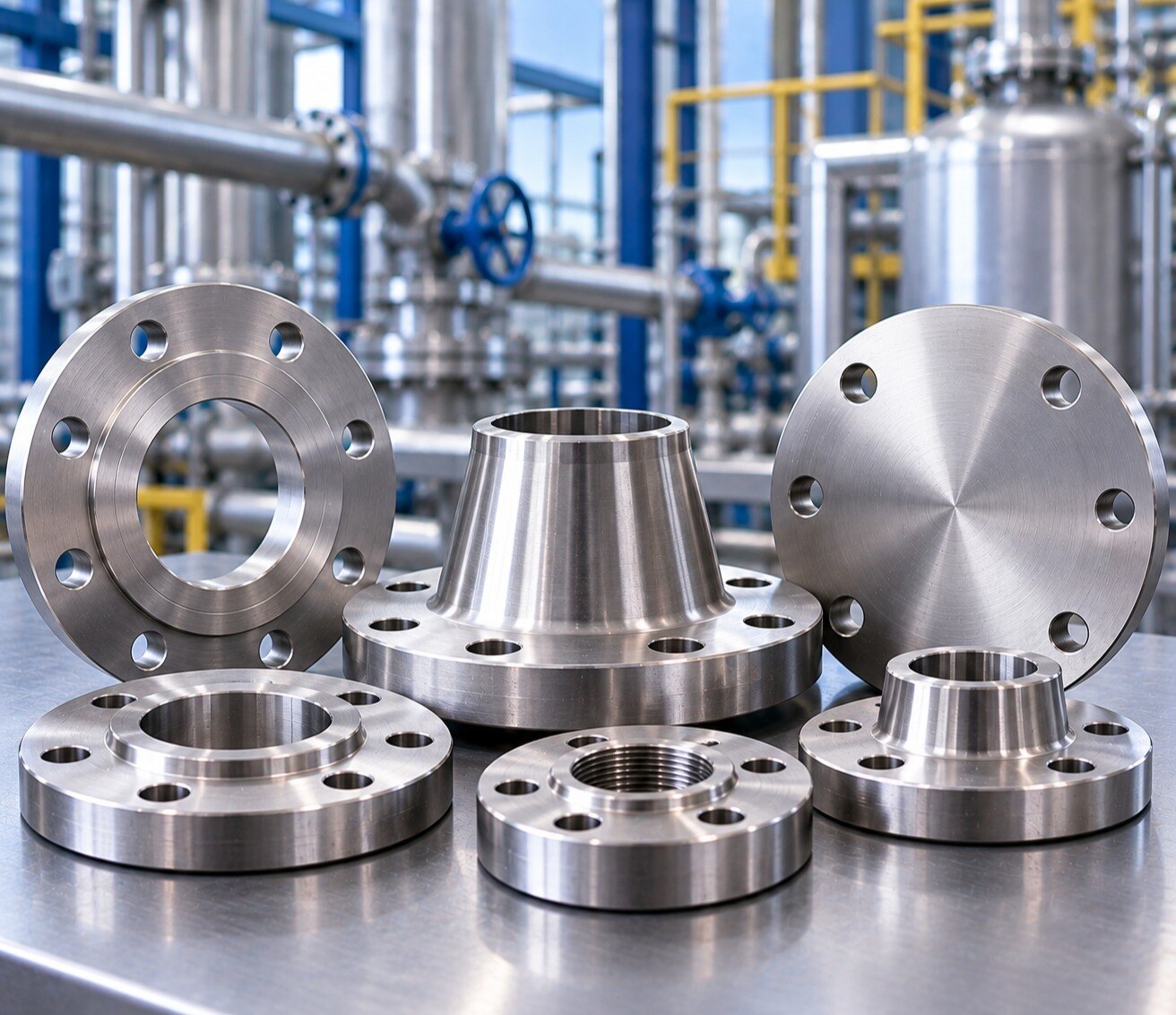
Industrial flanges cost more to install than a welded joint, but they earn that cost when you need to disconnect equipment, inspect a line, replace a valve or maintain pressure-boundary components. By the end, you will be able to compare joint types, reject unsuitable flange applications, verify piping flange specifications and judge whether local stock reduces lifecycle cost or creates compliance risk.
Key takeaways
- Use flanges at equipment connections requiring inspection or repeated removal.
- Avoid flanges on buried, permanent, low-maintenance pipe runs.
- Verify DN, pressure class, face type, material, drilling and documents.
- Match gasket, bolts, face finish and tightening sequence to prevent leaks.
When does a flanged joint justify its extra cost?
Flanges for piping projects earn their extra cost when a line connects pumps, valves, strainers, heat exchangers, tanks or removable equipment. They also pay off when operators need periodic inspection or maintenance requires repeated dismantling without cutting pipe. These are the strongest industrial flange benefits.
| Option | Strength | Limitation |
|---|---|---|
| Welded joint | Compact, permanent, with fewer leak paths | Requires qualified procedures; repairs require cutting and rewelding |
| Threaded connection | Practical for limited small-bore, low-pressure services | Threads can leak and corrode; unsuitable for many demanding services |
| Grooved coupling | Fast installation and tolerance for movement | Depends on correct gasket and coupling selection |
| Compression or ferrule | Clean, serviceable small-bore systems | Not a universal substitute for pressure-rated flanges |
| Flanged joint | Equipment removal and inspection without pipe cutting | Costs more for purchase, bolts, gaskets, alignment and assembly |
Choose a flange when serviceability and equipment access outweigh that installation effort. Welding is better for a permanent, compact run; threaded connections suit restricted utility applications. Grooved systems help where movement and installation speed matter, while compression or ferrule fittings fit clean small-bore work. Compare the full maintenance cycle, not the flange price alone.
Which Hyderabad project applications should avoid flanges?
Review welded joints first for permanently buried pipelines, cramped layouts with no wrench or bolt-removal clearance, and lines that will never need dismantling. A flange adds face alignment, gasket installation, bolt tightening and inspection, plus extra weight and space.
| Application | Prefer first | Why flanges lose |
|---|---|---|
| Permanently buried pipeline | Welded joint | Accessing bolts later requires excavation |
| Cramped pipe rack | Welded joint | Tools cannot reach the bolts or remove the joint |
| Small-bore, low-pressure utility | Threaded, compression or ferrule connection | A piping-class-approved alternative avoids unnecessary bolt sets |
For small-bore utility lines, verify that the threaded, compression or ferrule connection meets the project piping class, fluid service and pressure limits. Do not select flanges for piping projects from nominal pipe size alone: vibration, thermal movement, equipment connection, pipe supports, movement range, fluid hazard and the maintenance plan determine the joint system.
Calculate lifecycle cost before rejecting a welded line. Include access platforms, shutdown time, gasket and bolt replacement, weld inspection, field rework and the future cost of cutting the welded line for maintenance. Document the decision in the line list or piping class, especially for process, steam, chemical and fire-water services.
Industrial flanges for projects in Hyderabad deserve approval only when their access or maintenance value exceeds those added tasks.
Which dimensions and documents must you verify before ordering?
Prevent a nominally correct flange from becoming a nonconforming part by ordering against the line number or flange schedule, not NPS alone. Your piping flange specifications must match the actual pipe, joint and service.
- Verify nominal pipe size, outside diameter, bore, flange thickness, pressure class, facing type and finish, bolt-hole quantity, hole diameter, pitch-circle diameter, material grade, schedule compatibility and governing standard.
| Standard | Coverage | Critical check |
|---|---|---|
| ASME B16.5 | NPS 1/2 through NPS 24 | Confirm class, facing and drilling |
| ASME B16.47 Series A | NPS 26 through NPS 60 | Confirm Series A dimensions and bolt pattern |
| ASME B16.47 Series B | NPS 26 through NPS 60 | Series B is not interchangeable with Series A |
Match the bore to the actual pipe wall and schedule. An oversized bore creates an internal step and turbulence; an undersized bore obstructs flow or will not fit. A mismatched welding-end preparation can prevent fit-up or weaken the weld transition.
Require the heat or cast number, product standard, specified heat treatment, dimensional report and inspection results. An EN 10204 Type 3.1 certificate reports manufacturer inspection results; independent third-party acceptance must be specified separately for industrial flanges for projects in Hyderabad.
How do pressure class, flange face and gasket choice work together?
Class 150, 300 or 600 is not a simple pressure number. ASME pressure class combines dimensions with pressure-temperature ratings, so use the applicable material-group table: allowable pressure changes as temperature rises. Check the weakest pressure-boundary component, including pipe wall, bolts, gasket and corrosion allowance.
- Confirm the project piping class, design pressure and temperature, fluid, bore, material and emissions requirement before choosing a gasket. Spiral-wound and compressed non-asbestos gaskets must suit the specified facing; ASME B16.20 covers metallic gaskets, while ASME B16.21 covers nonmetallic flat gaskets.
- Match the face system. A raised-face flange needs its specified gasket and facing finish. A flat-face component joined to a raised-face flange demands controlled bolt loading and flange-stress review; excessive tightening can bend or crack the flat face.
- Treat an RTJ flange as a separate system. Its groove geometry must match the metallic ring, so do not substitute a raised-face gasket.
These checks belong in the piping flange specifications, not in a last-minute purchase decision. Review the project specification before ordering: a thicker flange alone does not improve safety if the gasket, bolts, pipe or connected equipment remains the limiting component. Proper selection delivers the industrial flange benefits of reliable containment and maintainable joints.
What installation work determines whether a flange stays leak-free?
A dimensionally correct flange can still leak if damaged faces, forced alignment, a reused gasket, mixed-grade bolts or uneven tightening leave the joint without uniform preload. Installation effort does not erase the industrial flange benefits, but it determines whether you receive them.
Use this sequence:
- Inspect both facing surfaces and every bolt hole for damage, corrosion and burrs.
- Confirm the gasket identity, size, pressure rating and orientation; never reuse it.
- Align the pipes without using bolts to pull a pipe into position.
- Install clean, undamaged bolts, nuts and washers of the specified grade.
- Tighten in the project’s cross-pattern sequence, in controlled passes.
- Verify the specified preload using the project’s approved method, not a generic torque value.
ASME PCC-1 is the reference for bolted-flange joint assembly, covering preparation, gasket installation, tightening sequence and verification. Vibration, thermal cycling and corrosive service make the project’s bolt, gasket and pipe-support requirements critical.
| Joint type | Lifecycle outcome | Installation consequence |
|---|---|---|
| Flanged | Removable equipment needs less future cutting and welding | Requires inspection and replacement consumables |
| Welded | Compact permanent connection | Repairs require cutting, welding and inspection |
| Threaded | Useful for limited small-bore service | Thread leakage and loosening need control |
For flanges for piping projects, plan periodic inspection and controlled assembly rather than relying on hand-tight installation.
When does buying from a Hyderabad stockist reduce total project cost?
Local buying reduces total cost only when the Hyderabad stock matches the approved configuration and avoids delay. For industrial flanges for projects in Hyderabad, location alone does not make a generic flange suitable: verify drilling, facing, bore, material grade, certificates and traceability.
Ask the flanges supplier in Hyderabad to quote against the project line list or flange schedule, not just NPS. Require:
- ASME B16.5 or ASME B16.47, pressure class and Series A or B where applicable
- Schedule bore, gasket requirement, facing finish and approved drilling
- Material grade, heat or cast number, product standard, inspection documents and delivery quantity
| Common stocked carbon-steel sizes | Fast replenishment and lower freight | Approved standard sizes with routine certification |
|---|---|---|
| Project-specific configuration | Longer manufacture or inspection lead time | Unusual bores, large diameters, special facings, alloy grades or third-party inspection |
| Nominally available but nonconforming flange | Rework and rejection risk | Mismatched bore, bolt pattern, facing or documentation |
Compare purchase price, freight, expedited manufacture, inspection rejection, field modification, shutdown delay and approved-stock holding. Mercury Metalinks is one Hyderabad-based industrial metal supplier and stockist to evaluate against these documents and dimensional drawings.
Flanges are worth buying when access, inspection or equipment removal has measurable value and the supplied configuration is fully traceable and compatible.
Related product
 | FLANGES FLANGES Products – Mercury Metalinks Mercury Metalinks is a trusted supplier and stockist of premium-quality Flanges, offering a comprehensive range of... |
Frequently asked questions
When does a flanged joint justify its extra cost?
Choose a flange when a line connects pumps, valves, strainers, heat exchangers, tanks or removable equipment, or when maintenance requires repeated dismantling without cutting pipe.
Which Hyderabad project applications should avoid flanges?
Avoid flanges on buried or permanently enclosed pipe runs where access is difficult and future dismantling is unlikely. A welded joint can reduce leak paths and maintenance points in those locations.
Which dimensions and documents must you verify before ordering?
Confirm nominal diameter, pressure class, flange standard, face type, outside diameter, bolt-hole count and pitch-circle diameter, bore, thickness, material grade and gasket dimensions. Request the purchase specification, material test certificate, heat or batch number and dimensional inspection record.
How do pressure class, flange face and gasket choice work together?
Select the pressure class for the design pressure and temperature, then match the flange face and gasket to the service, flange finish and allowable bolt loading. A gasket that does not suit the face or fluid can leak even when the flange class is correct.
What installation work determines whether a flange stays leak-free?
Clean and align the faces, inspect the gasket and threads, install the correct bolts, and tighten in a staged cross-pattern to the specified torque or tension. Do not use bolts to pull misaligned piping into position.