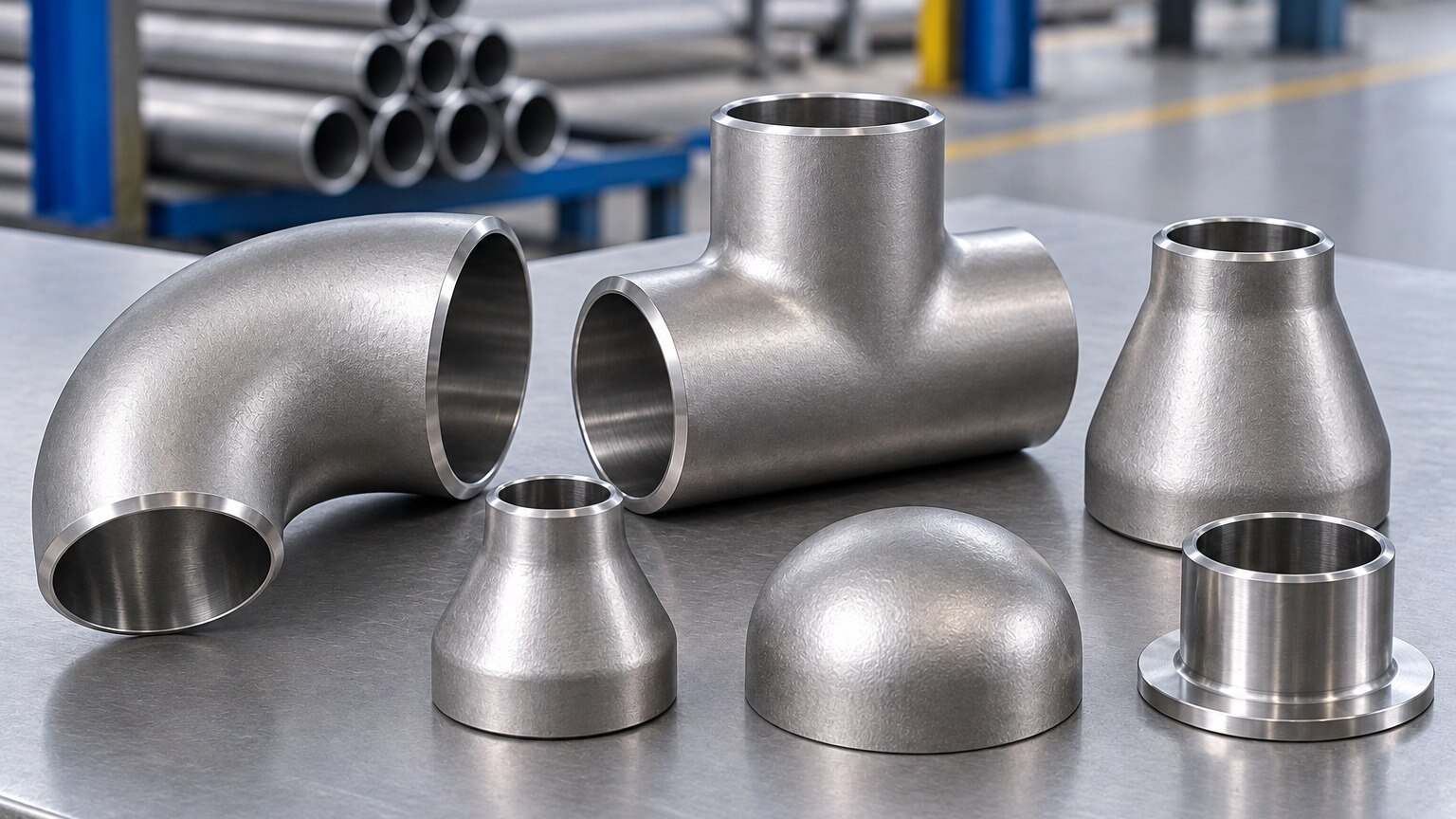
Butt weld fittings can reduce joint count and leakage exposure in permanent piping, but their value depends on welding access, inspection, coating repair, and future maintenance. By the end, you will be able to compare them with mechanical alternatives, choose the right fitting geometry and specification, and decide when the installed cost justifies a permanent welded connection.
Key takeaways
- Choose butt welds for permanent, integrity-critical lines with controlled welding.
- Compare installed risk, inspection, labour and downtime—not just fitting price.
- Match elbows, tees and reducers to flow, pressure, access and layout constraints.
- Confirm material grade, wall thickness, dimensions, weld ends and test documents.
When a permanent welded joint earns its cost
For the search question “are butt weld fittings worth it infrastructure projects?”, the practical answer is yes when the line is permanent, integrity-critical, and welds can be made repeatedly in a controlled shop. A continuous welded bore removes threaded engagement and the crevice at a socket or threaded connection, reducing leak paths and internal turbulence.
That advantage disappears when every joint demands difficult site access, extensive inspection, hot-work controls, and coating repair.
The cost case is strongest when:
- Shop fabrication concentrates welding into repeatable, qualified work, reducing field hours and fit-up variation.
- The service involves high pressure, high temperature, solids, pigging, or strict pressure-loss limits.
- The pipeline will remain in service for years, making leak prevention and fewer maintenance interventions worth the higher initial installation effort.
- The layout includes buried water, process, fire-water, or utility headers where permanent joints are preferable to frequent dismantling.
Butt weld fittings for construction are a poor financial choice for temporary services, scattered small-bore runs, restricted hot-work areas, or connections that operators must remove regularly. Flanges, grooved couplings, compression fittings, or threaded connections can install faster in those locations, even when each fitting costs more.
Include the complete cost: welding, welder qualification, non-destructive examination, access, shutdowns, and field coating repair. Welding also does not replace external corrosion protection; buried or marine carbon-steel lines still need the specified coating system, weld-joint repair, corrosion allowance, and cathodic protection where designed.
Butt weld fittings compared with mechanical and forged alternatives
The practical choice depends on permanence, bore quality, access, and maintenance. For a butt weld fittings comparison, welded joints suit shop-fabricated headers, buried water mains, process piping, fire-water rings, and high-pressure or high-temperature services. They remove threaded engagement and reduce gasketed leak points, but field welding, inspection, coating repair, and later modifications add cost.
| Option | Connection and bore | Best fit and limitation |
|---|---|---|
| Butt weld | Full-penetration welded joint; smooth bore | Permanent lines, pigging, solids, and controlled fabrication; needs qualified welding and inspection |
| Flanged | Bolted joint with gasket | Equipment connections and planned dismantling; adds weight, space, and gasket leak paths |
| Threaded | Engaged threads | Small-bore utilities and restricted hot work; crevices, lower bore continuity, and leakage complicate demanding service |
| Socket-weld | Pipe enters a forged socket, then fillet-welded | Compact small-bore, higher-pressure services; the socket recess can retain fluid and obstruct cleaning |
| Grooved | Grooved pipe joined with a coupling and gasket | Rapid installation and field changes; mechanical joints need access and gasket control |
| Compression | Ferrule or sleeve grips the pipe | Instrument and small-bore connections without welding; limited by tube size, vibration, pressure, and temperature |
| Forged | Manufacturing method, usually socket-weld or threaded | Compact high-pressure small-bore fittings; not a separate substitute for a butt-weld connection |
Do not judge flow from the joint alone. A 90-degree long-radius elbow has a 1.5D centreline radius and less disturbance than a short-radius 1.0D elbow, while reducer shape, weld intrusion, valves, and nearby fittings also determine pressure loss. Retain flanged or grooved joints where frequent dismantling or tie-ins are expected.
Choosing elbows, tees, reducers, caps, and laterals for real layouts
A 90-degree change in a main line usually starts with a long-radius elbow: its centreline radius is 1.5 times nominal pipe size, reducing turbulence and pressure loss. Use a short-radius elbow, at 1.0 times nominal pipe size, only when space controls the layout and the hydraulic calculation accepts the added loss.
| Fitting | Choose it for | Positioning rule |
|---|---|---|
| Elbow | Direction changes in water, process, fire-water, and utility lines | Keep long-radius elbows near pumps, meters, and control valves; use short-radius only with clearance and pressure-loss checks |
| Tee | A branch requiring equal or near-equal access | Keep the branch aligned with the take-off and provide support; avoid placing it immediately against a pump nozzle or valve |
| Lateral | An angled branch with a smoother flow path | Point the branch in the direction of flow where the project standard permits; use it instead of a tee only after checking branch flow and reinforcement |
| Reducer | Transition between nominal pipe sizes | Use concentric reducers in vertical runs or where symmetry matters; use eccentric reducers to maintain a flat top or bottom and prevent gas or liquid pockets |
| Cap | A permanent dead end, drainable termination, or future branch | Add a drain or vent where trapped fluid, air, or pressure could create a maintenance hazard |
Keep straight pipe between fittings and sensitive equipment when the layout standard requires it. At pump suction, avoid an eccentric reducer orientation that creates an air pocket; in liquid lines, a flat-bottom arrangement can prevent liquid trapping. Verify the fitting wall, material, temperature, corrosion allowance, and piping-code design before treating any geometry as interchangeable.
The specification and fit-up checks that prevent expensive rework
Do not release a butt-weld fitting until its end preparation, material identity, and welding package agree with the pipe isometric and piping code. Check outside diameter, wall thickness, bevel angle, root face, root gap, and internal hi-lo. A mismatch with ASME B16.25 geometry can cause field grinding, an unapproved transition, or scrap.
| Check | Required match or evidence | Hold point |
|---|---|---|
| Dimensions | Pipe OD, wall thickness, bevel, root face, and fitting dimensions match the drawing and ASME B16.25 | Stop for excessive hi-lo, wrong root gap, or forced alignment |
| Material | Grade, specification, wall thickness, heat treatment, and corrosion allowance match the design | Reject unclear markings; perform positive material identification when specified |
| Traceability | Fitting marking links to the heat number and EN 10204 Type 3.1 material certificate | Hold any certificate that cannot be tied to the supplied fitting |
| Welding | Approved WPS/PQR, qualified welder, purge gas, preheat, interpass temperature, and consumables are defined | Do not weld without controls for stainless, duplex, or nickel alloys |
| Inspection | ITP names visual inspection, RT or UT, PT or MT, acceptance criteria, and repair limits | Require signed reports and documented approval of every repair |
- For stainless, duplex, and nickel alloys, record purge quality and interpass temperature; duplex work also needs the specified ferrite or phase-balance control.
- Confirm the fitting’s material, thickness, design temperature, weld qualification, and piping code establish pressure suitability; nominal size and schedule alone do not.
- Release the joint only after heat-number continuity, welder qualification, inspection results, and coating-repair requirements are complete.
How to compare suppliers by installed risk, not piece price
A cheaper elbow becomes expensive when its wall thickness, end preparation, or material certificate forces a site substitution. Compare each butt weld fitting supplier in Hyderabad against the installed-risk checklist, not the quotation’s unit rate.
Require these documents and controls before placing the order:
- The named standard and edition, such as ASME B16.9, plus size, schedule, material specification, and seamless or welded construction.
- A heat-number traceable MTC stating chemical analysis, mechanical results, heat treatment, and testing; confirm that markings on every fitting match the certificate.
- A dimensional report covering outside diameter, wall thickness, centre-to-end dimensions, bevel angle, and tolerance.
- The project line class, corrosion allowance, NDE method and acceptance criteria, packing method, and delivery plan for the complete size range.
- Welding requirements covering the WPS, qualified welders, root gap, internal purge for stainless or nickel alloys, repair limits, and inspection records.
| Supplier check | Low installed-risk evidence | Warning sign |
|---|---|---|
| Standard and fit | ASME B16.9 edition, schedule, bevel, and line class match | “Equivalent” offered without written approval |
| Traceability | Heat number follows fitting, MTC, and packing list | Mixed heats or unreadable markings |
| Weld readiness | Controlled ends, clean packaging, complete NDE records | Rework discovered during fit-up |
| Availability | Matching elbows, tees, reducers, and caps from one specification | Partial range requiring substitutions |
For piping fittings for infrastructure, local stock saves time only when it preserves one standard and traceable heat history. Mercury Metalinks belongs in the comparison when it can document those details, not merely quote a stocked item.
Related product
 | BUTT-WELD FITTINGS Mercury Metalinks Mercury Metalinks is a trusted supplier and stockist of premium-quality Butt-Weld Fittings, offering a comprehensive range of... View product → |
Frequently asked questions
When are butt weld fittings worth the cost for infrastructure projects?
They earn their cost on permanent, integrity-critical lines where controlled welding, inspection and long service life justify the fabrication effort.
How do butt weld fittings compare with mechanical and forged alternatives?
Butt weld fittings provide a continuous welded bore, while mechanical joints simplify installation and forged fittings suit compact, high-pressure connections; compare leakage risk, access, labour and inspection.
How do you choose elbows, tees, reducers, caps and laterals?
Select each fitting by line size, flow direction, pressure, wall thickness, bend radius, branch geometry, maintenance access and the actual layout.
What specification and fit-up checks prevent rework?
Verify the material grade, schedule or wall thickness, dimensions, weld-end preparation, heat treatment, inspection requirements, certificates and alignment before fabrication.